
Almost a decade ago, people would have laughed at you if you told them that computers can understand human language and respond to our queries. Technological progress has brought the world to a stage where that distant dream has turned into a reality. Companies are more interested in building conversational AI experiences as popular examples such as Alexa and Siri showcase what conversational AI is capable of.
The global conversational AI market delivered almost $14 billion as revenue in 2025 (Source). On top of it, 44% of US businesses are paying for AI tools, thereby presenting a promising opportunity to build conversational AI tools (Source). This guide will help you understand the components and models used in conversational AI tools with insights on notable use cases.
Level up your AI skills and embark on a journey to build a successful career in AI with our Certified AI Professional (CAIP)™ program.
Introducing Conversational AI and How It Works
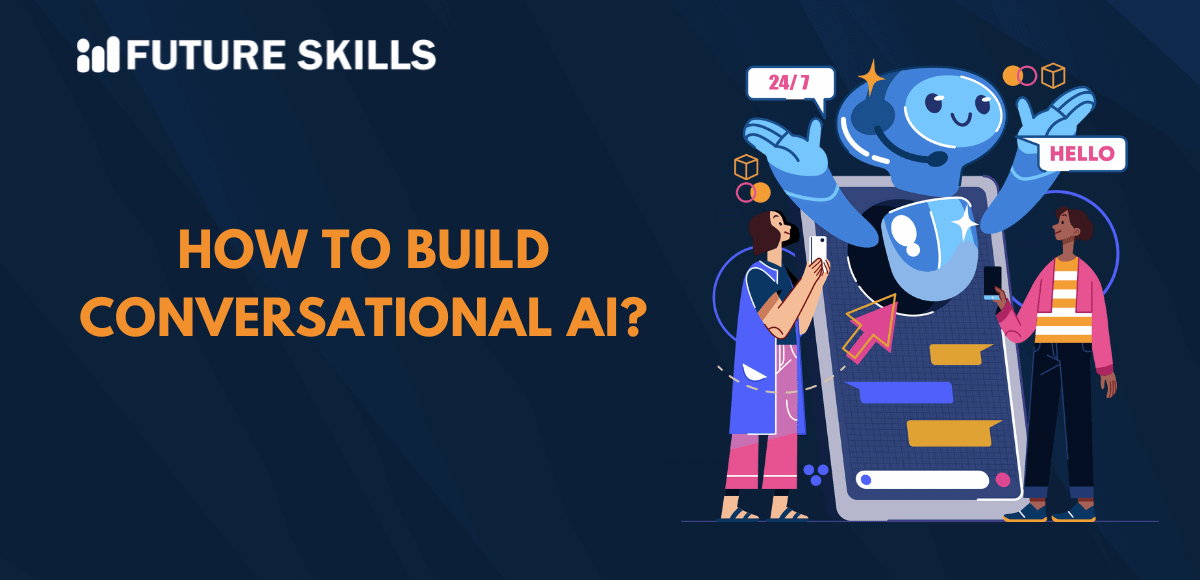
The ideal approach to build conversational AI begins with an understanding of what it means. Conversational AI points at a specific type of artificial intelligence that helps computers in understanding and responding to human language. The process to build conversational AI chatbot involves a blend of machine learning and natural language processing. You should also know that chatbots are not the only conversational AI tools in the market. Conversational AI is also the driving force behind virtual assistants and many voice-powered applications.
Conversational AI systems use natural language processing to break down and understand the user input, provided in text or speech. The system understands key information in user input as well as the user’s intent. In the next step, the conversational AI leverages machine learning models to come up with the most relevant response. The AI learns from user feedback and improves continuously by learning from patterns and context in subsequent interactions. As a result, the responses by conversational AI become more personalized and seamless with gradual use.
Identifying the Key Technologies that Drive Conversational AI
The complexity of human conversations is still a challenge for many people and you may have felt it too at some point in life. How do you think machines can address this challenge? The key technologies that define conversational AI architecture help in managing communication between machines and human users. Conversational AI relies on the following technologies,
- Machine learning
- Natural language processing
- Deep learning
- Text-to-speech and Speech-to-text
The role of each technology in the architecture of conversational AI systems showcases how they make machines understand and talk in human language.
-
Machine Learning
The primary goal of machine learning algorithms in conversational AI systems is to use data from NLP to make decisions and learn new patterns and contexts. Machine learning models evaluate patterns in the input data and learn from their interactions with users. The continuous learning process results in formation of a feedback loop that makes the conversational AI system more accurate and context-aware.
Build a strong foundation in machine learning and step confidently into the future of AI with the Machine Learning Essentials Course.
-
Natural Language Processing
You cannot think about machines dealing with human language without natural language processing. NLP helps machines understand natural human language in speech and text and produce responses. The power of NLP in conversational AI comes from two distinct subsets, natural language understanding and natural language generation. NLU focuses on evaluating the semantics and grammar in human language to understand its meaning while NLG generates responses in human language to user input.
-
Deep Learning
Deep learning is a more sophisticated approach to machine learning that helps in extracting high-level features from user input. The utility of deep learning in building conversational AI systems focuses on detecting intent and speech recognition. Deep learning empowers conversational AI to manage large sets of unstructured data in the form of text, voice and sentiments.
-
Text-to-Speech and Speech-to-Text
The functionalities of conversational AI would have been limited without the translation of text responses to speech and user speech inputs into text. Text-to-speech helps in converting the text responses of conversational AI to speech, which is audible to users. On the other hand, speech-to-text facilitates automatic speech recognition, which involves converting the speech of users into text. New conversational AI systems use deep learning to capture subtle nuances in emotion, pronunciation and intonation in text-to-speech. Deep learning also empowers neural language and acoustic models to manage different slang and accents.
Level up your ChatGPT skills and kickstart your journey towards superhuman capabilities with Free ChatGPT and AI Fundamental Course.
Unraveling the Best Roadmap to Build Conversational AI
The overview of key technologies used in conversational AI systems provides a clear impression of what you have to deal with in conversational AI development. Your search for answers to “How to build conversational AI?” will lead you to different approaches for planning and developing the architecture for conversational AI systems.
Creating conversational AI systems requires a strategic process in which you train models and refine each component to achieve the desired results. The following steps will help you understand the types of models you can use in conversational AI and other crucial processes to develop conversational AI systems.
1. Planning for Your Conversational AI System
Ask any expert and they will recommend that you should focus on planning before you develop a conversational AI system. The planning stage should help you determine the potential use case where the conversational AI will be most helpful. During the planning stage, you have to define goals, establish requirements and prepare an outline of technical tasks.
Your goals may focus on enhancing interactions, automation of high-volume conversations or delivering personalized recommendations. Developers should also focus on achieving compliance with data privacy regulations from the first step to avoid complications in future.
2. Designing the Architecture of the Conversational AI
The second phase in development of conversational AI revolves around mapping the user flow and defining the architecture. The conversational AI architecture defined in this phase should align with client requirements alongside making interactions effective and highly relevant. You should know that designing the architecture of your new conversational AI system will take a few weeks.
The architecture should provide clear specification for a user interface design that is not only attractive but also easy to navigate. Developers should also design dialogue flows and content policies to guide the responses of the conversational AI. Content policies can include business rules about specific actions and safety rules for situations where the conversational AI should not respond.
3. Collecting and Preparing Data
You cannot think about developing a conversational AI chatbot without high-quality data for the concerned tasks. Developers can build conversational AI chatbot with the help of existing data, obtained from official documentation. It is important to ensure that the data is relevant, updated and sufficient for the task at hand.
In the event of lack of relevant internal data, you have to collect data from external sources, such as public datasets. Once you have obtained the suitable data, the development team has to refine it and remove irrelevant details. The next step involves data normalization, which binds the refined data within standard data formats. You should also rely on data annotators to attach labels to the data that will make it easier to understand for AI.
4. Developing the Conversational AI
The most intensive stage of the conversational AI development process is the actual development. At this stage, you will have to choose the ideal conversational AI model or framework for your project. The first option involves training your own conversational AI model by using one of the classic models. You can choose Recurrent Neural Networks, Long Short-term Memory Networks or Transformer models, depending on your requirements.
Another common approach to build conversational AI involves using pre-trained models with your data to perform desired tasks. Developers can also leverage LLMs through APIs in your conversational AI applications to avoid the stress of building the underlying models from scratch. Popular conversational AI frameworks, such as IBM WatsonX Assistant, offer a simpler development process.
5. Conversational AI Testing and Deployment
Once you have completed the development phase, you must use conversational AI testing tools to ensure that your system works as intended. The notable metrics used in building conversational AI include response time, accuracy and resolution time. It is also important to note the number of queries the system needs to solve a user’s question and how many times it fails to answer queries.
The final step involves actual deployment of the conversational AI system with MLOps. It plays a crucial role in automating the deployment process alongside supporting performance monitoring and management of the model lifecycle. You can initially release the conversational AI in a controlled environment to analyze its performance and interactions.
Want to gain practical skills in using OpenAI API and implementing API calls to facilitate LLM interactions, Enroll now in the Certified Prompt Engineering Expert (CPEE)™ Certification.
Final Thoughts
The process to build your own conversational AI system is quite straightforward. You can use conversational AI for different use cases across different industries, which shows why the demand for creating conversational AI has increased in recent times. Conversational AI tools work with a combination of machine learning models, natural language processing and deep learning. Learn more about choosing the ideal technologies for your next conversational AI project.
FAQs
Can AI certification improve my job prospects in tech?
Yes, AI certifications like the Certified AI Professional (CAIP)™ certification by Future Skills Academy can improve your job prospects in tech. The certification course helps you learn AI like a pro and cover all concepts from scratch. It also provides a deep dive into the practical applications of AI with hands-on experience and shows how AI can be used in any workplace.
How does conversational AI work?
Conversational AI works with a combination of machine learning and natural language processing. NLP helps the conversational AI understand user input by breaking down text or speech to extract intent and semantics. The machine learning model evaluates the user input and generates a relevant response. Machine learning also empowers the conversational AI to learn continuously from patterns and context in user inputs and user feedback to improve responses.
Where is conversational AI used in real-world applications?
You can find the most popular real-world applications of conversational AI in retail and ecommerce. The chatbots used in various ecommerce stores and virtual shopping assistants are the ideal examples of real-world conversational AI applications. Conversational AI is also used in automated booking assistance and customer query resolution in healthcare. The education sector also hosts many conversational AI applications for personalized learning.
About Author

James Mitchell is a seasoned technology writer and industry expert with a passion for exploring the latest advancements in artificial intelligence, machine learning, and emerging technologies. With a knack for simplifying complex concepts, James brings a wealth of knowledge and insight to his articles, helping readers stay informed and inspired in the ever-evolving world of tech.