
AI agents don’t qualify as niche experiments anymore as they shift towards production workloads in real use cases. The utility of agentic AI in executing financial workflows, resolving IT incidents, and handling API integrations has drawn significant attention. The primary goal of a guide on AgentOps explained for beginners revolves around helping you understand how it helps you get the desired results from AI agents.
- G2 published a new report, which states that almost 60% of organizations have deployed AI agents in production (Source).
- Latest research by Gartner predicts that AI agents will be responsible for completing almost 90% of B2B purchases by 2028 (Source).
- Fewer than 50% of organizations that adopt AI agents have introduced fundamental changes in their operating models (Source).
Why do you think it is important to focus on the operating models of AI agents? The biggest challenge with AI agents is that they learn, adapt, and evolve, thereby creating more probability for unpredictable behavior. With some organizations formalizing AgentOps practices, specifically in highly regulated sectors, the curiosity to learn about AgentOps is growing. You must know the meaning of AgentOps and understand its significance in the modern AI landscape to embrace its benefits in the best way possible.
Gain in-demand skills to manage agentic AI workflows across the full AI agent lifecycle with the Certified AI Agents Manager (CAIAM)™ Certification
Definition of AgentOps Explained for Beginners in AI
The AI space has shifted towards autonomous agents that have the ability to perceive, learn, and act without human intervention. AI agents use large language models, memory modules, and capabilities to use tools, which represent the next big thing in enterprise automation. The answers to “What is AgentOps?” focus significantly on a prominent challenge that you will find solely with AI agents. AI agents are dynamic and more context-aware with abilities for independent reasoning and interacting with APIs and humans.
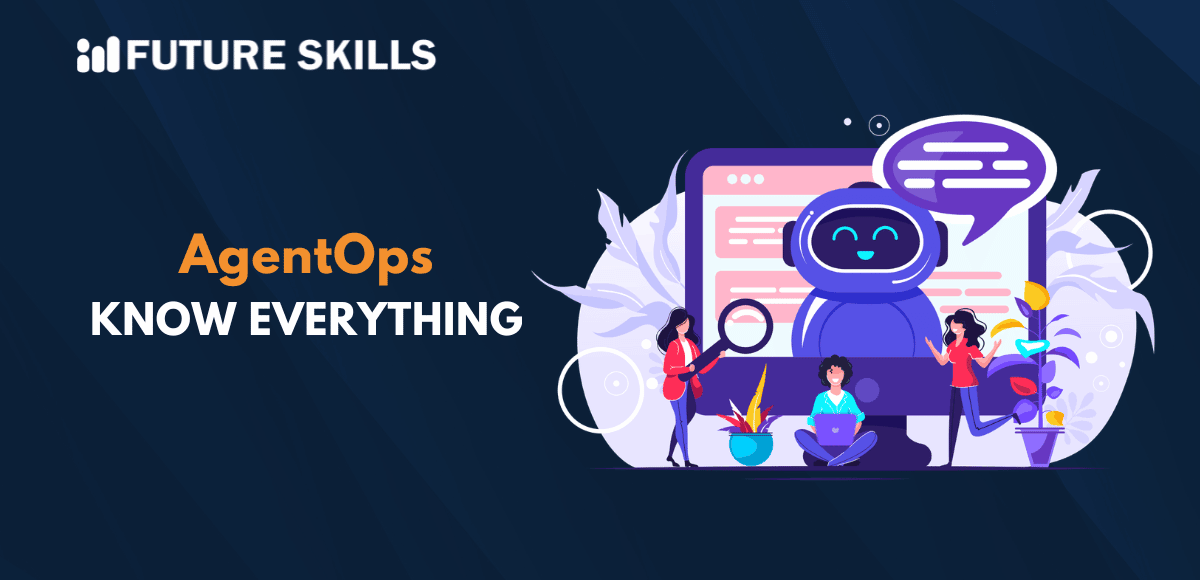
As more organizations adopt AI agents for workflow automation, they notice challenges in monitoring the behavior of agents. AgentOps represents the collection of best practices, tools, and frameworks to evaluate agent performance and ensure that they work as intended. The scope of AgentOps encompasses everything in the agentic AI lifecycle, including designing, deploying, monitoring, optimizing, and governing autonomous AI agents.
The primary idea of AgentOps draws inspiration from precedents in DevOps and MLOps. It focuses on introducing transparency and reliability in the agentic AI space and help developers gain complete visibility into agent interactions and behavior. AgentOps helps in achieving almost perfect alignment between behavior of AI agents and business and compliance goals. You can also think of AgentOps as an improvement over traditional DevOps and MLOps to provide an operational layer for AI agents.
Understanding the Significance of AgentOps in 2026
The most important concern on everyone’s mind right now is the list of reasons to focus on AgentOps in the modern AI space. Companies adopting agentic AI must know that with regular operations, agentic AI systems also push exponential growth in complexity. The AgentOps Google SDK, launched in 2024 is one of the best examples to prove how big names in the world of technology have taken note of AgentOps.
AI agents are capable of learning from context, collaborating with other agents, and act on their own without human instructions. The autonomy of AI agents may seem like a colossal advantage for workflow automation albeit with new challenges. Deploying AI agents creates multiple challenges, including
- External dependencies
- Security vulnerabilities
- Higher operational costs
- Unpredictable reasoning
- Compliance risks
Why can’t you rely on traditional DevOps and MLOps pipelines for AI agents? The traditional operations models work with specific assumptions, such as deterministic behavior, clear constraints, short-lived execution, and human intervention. AI agents are completely different as they are non-deterministic, autonomous, and capable of acting on real problems.
AgentOps fills the gap in monitoring AI agents by providing a continuous framework that enables observation, evaluation, governance, feedback, versioning, and security across the lifecycle of every AI agent. As a result, AI agents can transition from being a mere research experiment into a reliable enterprise component. Developers can rely on AgentOps to observe the end-to-end behavior of AI agents and use real-time data from different stages of the agent lifecycle to optimize agents.
Enroll in the world’s best Free AI Course and build a strong foundation. Explore new opportunities to pursue a career in AI.
How Will AgentOps Help Organizations Adopting Agentic AI?
The growing use of AI agents, even in experimentation and pilot stages, clearly showcases that they will become an integral component of business workflows in future. It is important to know the benefits of AgentOps for AI adoption in the long run to understand why it is the need of the hour now. Businesses adopting AI agents can leverage AgentOps to achieve various benefits, and identifying the benefits can tell you a lot about its value.
-
Transparency
AgentOps provides the assurance of complete transparency into agent behavior, reasoning flows, user interactions, and external API calls in one operational layer.
-
Cost Control
The transparency into token usage and API expenses provides room for cost control along with the facility of setting alerts for cost spikes.
-
Real-Time Monitoring
The use of AgentOps for real-time anomaly detection helps developer teams respond to discrepancies in agentic AI workflows before they escalate into bigger problems.
-
Safety and Compliance
AgentOps also ensures that AI agents work according to the desired benchmarks of security and efficiency. It also makes AI agents more predictable while achieving compliance with business goals.
-
Comprehensive Analytics
One of the significant reasons to focus on AgentOps is the facility of analytics that offer granular impression of agent performance. You can use session-wide metrics or the tool and API usage analytics to determine how well your AI agents are working.
Enroll now in the AI for Business Course to Understand the role and benefits of AI in business and the integration of AI in business.
Unraveling the Core Principles of AgentOps
The ideal solution to leverage AgentOps tools requires in-depth understanding of the core principles in AgentOps. You should understand the interconnected principles of AgentOps to achieve the most effective agentic AI implementations and governance at scale.
-
Observation
The foremost principle in AgentOps focuses on ensuring that the actions of AI agents can be observed. It means that you can see reasoning traces, tools called by agents, decisions taken by them, and the outputs generated by AI agents.
-
Reliability and Control
AI agents should work within specific constraints, even in the case of probabilistic outcomes, to comply with the principle of reliability. How does AgentOps achieve this? AgentOps provides the guidelines to establish guardrails and rate limits for AI agents and ensures that agents work within your control.
-
Lifecycle Management
The most notable highlight of AgentOps is that it applies to the full lifecycle of an agentic AI workflow. AgentOps help you manage the design, testing, deployment, monitoring, and optimization of AI agents in one operational layer.
-
Resource and Cost Efficiency
You must have noticed that every definition of AgentOps explained how it aims to improve efficiency in resource usage. AI agents consume memory, tokens, compute resources, and time to achieve their goals. AgentOps helps in tracking token usage, throughput, cost for each task, and latency to monitor resource usage patterns.
-
Multi-agent Orchestration
The effectiveness of AgentOps revolves largely around the ability to ensure effective coordination between multiple AI agents. AgentOps helps in managing agent-to-agent coordination and task handoffs alongside resolving dependencies and resolving conflicts.
-
Governance and Safety
The list of core principles underlying AgentOps will be incomplete without governance. AgentOps ensures that autonomous AI agents follow organizational policies, ethical guidelines, and relevant regulatory requirements. As a result, AgentOps plays a vital role in strengthening auditing and enforcement in AI agent systems.
Final Thoughts
The overview of AgentOps and its significance clearly showcase how it will define the future of AI. Organizations have been turning towards AI agents in large numbers, primarily to capitalize on the benefits of workflow automation. However, autonomy of AI agents also brings a new set of challenges, largely associated with transparency into agent behavior. AgentOps provides the answer to monitor agent behavior and interactions with other agents, thereby enabling access to insights for effective optimization of agentic AI workflows. Learn more about AI agents and discover the best practices of AgentOps now.
FAQs
What is AgentOps and how does it work?
AgentOps represents a specialized set of best practices, tools, and frameworks to develop, monitor, and manage the complete lifecycle of AI agents. It works by combining the principles of DevOps and MLOps, effectively extending them, to handle the complex operations of AI systems. AgentOps manages the non-deterministic behavior of AI agents to ensure cost-efficiency, reliability, and security.
What is the core concept behind managing AI agent operations?
The core concept behind managing AI agent operations is agentic orchestration. It focuses on ensuring coordination between perception, reasoning, planning, and memory of AI agents to execute autonomous actions. Managing AgentOps revolves around empowering agents to perceive their environment, implement logic to achieve desired goals, and use relevant tools safely through continuous oversight.
Which companies offer AgentOps solutions?
You can find many companies, including startups and established tech giants, along with AI service providers offering AgentOps solutions. The AgentOps.ai SDK by Google is one of the examples of how big tech companies offer AgentOps solutions. IBM is also another top company offering AgentOps solutions by using its WatsonX platform.
Where can I find AI certification courses that include hands-on projects?
You can find AI certification courses with hands-on projects on Future Skills Academy. The training and certification platform offers hands-on projects in its certification programs to empower learners with practical skills. The hands-on exercises also help learners with an in-depth understanding of crucial concepts in every module. As a result, learners can connect the dots effectively and leave little room for inefficiency in real-world situations.
About Author

David Miller is a dedicated content writer and customer relationship specialist at Future Skills Academy. With a passion for technology, he specializes in crafting insightful articles on AI, machine learning, and deep learning. David's expertise lies in creating engaging content that educates and inspires readers, helping them stay updated on the latest trends and advancements in the tech industry.