
AI agents have finally moved over the initial hype and emerged as powerful tools to introduce meaningful improvements in actual products and workflows. The utility of these agents in complex tasks that require reasoning gives a strong reason to continue using AI agents. The curiosity to learn about AI agents frameworks and the broader agentic AI ecosystem is growing steadily as agentic solutions help with more complex workflows.
- IDC has predicted that 40% of jobs in large global enterprises will require working with AI agents by 2027 (Source).
- McKinsey believes that AI agents will unlock economic value of almost $2.9 trillion in the US alone by 2030 (Source).
- The global agentic AI market is expected to achieve the market cap of $10.86 billion in 2026 (Source).
If there’s one thing you should know about AI agents, it is the fact that agentic AI is no longer a niche experiment. As a matter of fact, agentic AI has given birth to an ecosystem of frameworks and tools that serve distinct functionalities. You must know about the AI agent stack and notable frameworks that you must use to work with AI agents to achieve successful results.
Gain in-demand skills to manage agentic AI workflows across the full AI agent lifecycle with the Certified AI Agents Manager (CAIAM)™ Certification
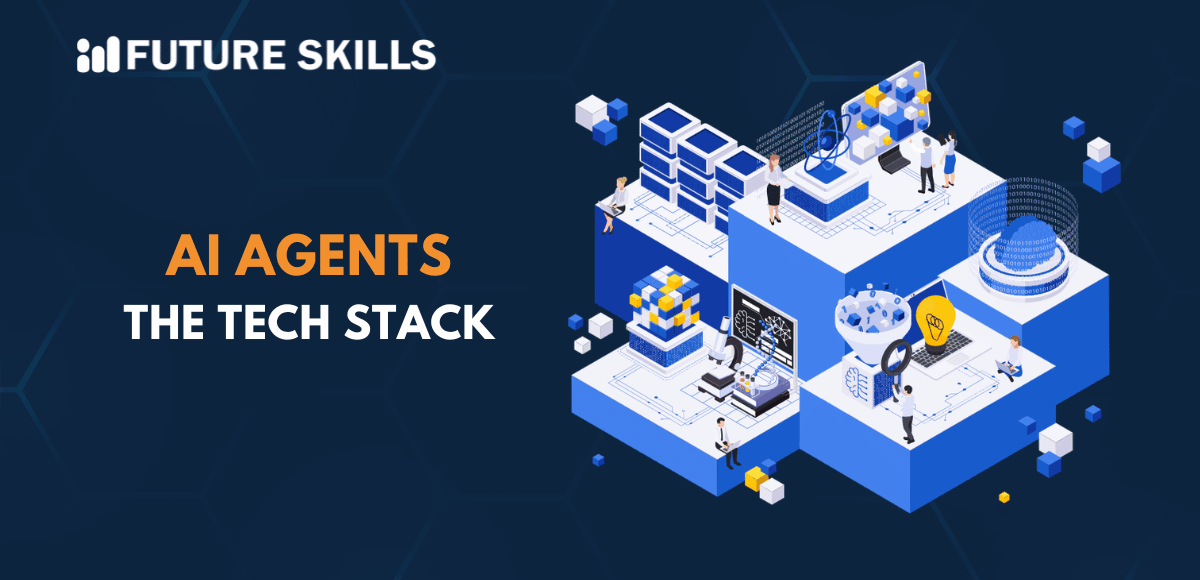
Unraveling the Layers in an AI Agent Stack
The best way to understand the agentic AI ecosystem requires a high-level overview of the AI agent stack. You can use the AI agent stack to learn about the major layers of AI agents ecosystem that developers work with. The review of different layers in an AI agent stack will help you identify their utility in agentic AI workflows.
-
Agent Framework and Logic Layer
The agent framework and logic layer is responsible for defining the agent behavior and decision-making logic. In this layer, frameworks provide abstraction for workflows for planning, reasoning, multi-agent coordination, and tool calling. The frameworks in this layer can follow code-centric approaches that offer better control over agent behavior. On the other hand, low-code visual platforms like n8n in this layer provide the advantages of visual agent development.
-
Retrieval and Augmentation Layer
The retrieval and augmentation layer in the AI agent stack establishes correlation between agent responses and external knowledge. Retrieval-Augmented Generation or RAG is the core element in this layer along with vector databases that enable semantic search and frameworks to manage the retrieval and generation pipeline.
-
Agent Memory Layer
The overview of an AI agent tools list will also require understanding the implications of the agent memory layer. It is responsible for helping AI agents in maintaining persistent context and learning from past interactions throughout different sessions.
-
Runtime and Orchestration Layer
The runtime and orchestration layer focuses on managing the execution lifecycle of agentic workflows. It is responsible for ensuring that agents can pick up from checkpoints and manage concurrent executions while providing more transparency into the execution process.
-
Inference and Serving Layer
You will need the inference and serving layer to make the most of foundation models that drive agent reasoning. It now includes sophisticated systems that offer functionalities like load balancing, model routing, cost optimization, and prompt caching.
-
Compute and Acceleration Layer
The compute and acceleration layer offers specialized hardware that helps with model inference and training. You will find cloud GPU providers, custom ASICs, and specialized tensor processing units in this layer of agentic AI ecosystem.
-
Observation and Monitoring Layer
You cannot think of creating agentic workflows with transparency into agent behavior without the observation and monitoring layer. It leverages different techniques, such as tracing and anomaly detection, to offer complete visibility into the behavior of AI agents.
Learn the best AI techniques to boost your business with our unique AI for Business Course. Enroll today!
What are the Top AI Agents Frameworks in 2026?
The agentic AI ecosystem offers a wide range of tools and frameworks, each tailored for distinct use cases and requirements. You have to learn about the strengths and utility of popular agentic AI frameworks to discover how they help in achieving business goals. If you want the best AI agent framework to build custom agents, then you should choose the ideal framework that aligns with your needs.
1. LangGraph
 The most popular agentic AI framework you can use now is LangGraph, which is a specialized framework in the LangChain ecosystem. It is a trusted framework to build controllable and stateful agents with streaming support. On top of it, LangChain SDK offers the foundational blocks to connect models, APIs, and data stores. LangGraph has shown promising levels of enterprise adoption with almost 4.2 million monthly downloads.
LangGraph is the best agentic AI framework for stateful agent orchestration by maintaining context throughout different interactions. It also offers multi-agent support along with flexibility to design single-agent, sequential, and hierarchical workflows. The LangSmith integration with LangGraph provides the advantage of in-built monitoring and performance tracking capabilities. One of the most interesting features of LangGraph is the scope for including human-in-the-loop workflows to introduce manual intervention points.
2. CrewAI
 Your search for the most commonly used AI agent frameworks will also lead you to CrewAI. It stands out for its focus on orchestration clarity and human-readable, collaborative agent teams. CrewAI is one of the top AI agents frameworks that work through clear definition of roles, goals and tasks for agents. Subsequently, it also helps you determine the structure in which agents hand off work in process-driven workflows. The biggest strength of CrewAI is the ability to abstract lower-level complexity to facilitate task completion and agent interaction.
CrewAI has become one of the popular choices for use cases in marketing automation and customer service. The popularity of CrewAI revolves largely around the assurance of minimal coding to setup new agents. It also works without complex framework dependencies and offers an easier learning curve. You must know that CrewAI is a top framework for designing multi-agent systems with collaborative workflows, where every agent takes on specific responsibilities.
Learn how to use AI and generative AI skills in your business or work with our AI for Everyone Free Course. Enroll now!
3. OpenAI Agents SDK
 OpenAI Agents SDK is also another reliable framework in agentic AI to create multi-agent workflows. The lightweight Python framework offers the ideal resources to create multi-agent systems with comprehensive tracing and guardrails. OpenAI Agents SDK is one of the few frameworks in the AI agents ecosystem that follow a minimalist and pragmatic approach. You can use a streamlined API in the framework for core tasks of AI agents, such as reasoning and iterative execution.
The most important feature of OpenAI Agents SDK is the lightweight design that translates in minimal overhead for multi-agent systems. It also offers the flexibility to work with more than 100 different language models in agentic AI workflows. Furthermore, OpenAI Agents SDK offers comprehensive monitoring and debugging capabilities alongside seamless integration with OpenAI services. OpenAI Agents SDK is also a reliable framework for security with in-built safety mechanisms and behavior controls.
4. Microsoft Agent Framework
 You cannot create a list of popular AI agent frameworks without including Microsoft Agent framework in it. The most notable strength of Microsoft Agent framework is that it is a sophisticated multi-agent system framework. It can help you manage specialized agents that work in collaboration and Semantic Kernel offers secure pipelines for enterprise data and Azure services. Microsoft Agent framework is the ideal choice for agentic AI applications in highly regulated industries.
The primary reason to trust Microsoft Agent framework is the in-built enterprise security posture. In addition, it also offers sophisticated orchestration patterns for conversational multi-agent systems. The seamless native alignment with Microsoft Azure services along with the broader collection of Microsoft tools also makes Microsoft Agent framework an ideal tool for larger organizations.
Final Thoughts
The review of the different AI agents frameworks shows that the agentic AI ecosystem is not limited to few tools. Over the course of time, agentic AI tools and frameworks will become a must-have skill for working with AI. The notable frameworks, such as LangGraph, CrewAI, Microsoft Agent framework and OpenAI Agents SDK have unique strengths. You can review the features and utilities of different frameworks and make the ideal decision for your agentic AI workflows.
FAQs
What are the foundational concepts behind AI agent development platforms?
The foundational concepts behind AI agent development platforms revolve around creating autonomous systems with capabilities for reasoning, planning and acting on behalf of users. You must learn about concepts of autonomy and goal orientation, cognitive architecture, observation, governance, and orchestration to work with agentic AI.
How to get started with building a simple AI agent using a common framework?
The best approach to start building a simple AI agent requires choosing a framework that aligns with your technical fluency. You can then define the outline of the specific task and set up the environment with the selected framework. The next step will involve creating functions for agents to call, including file readers or web search tools. Subsequently, you can create the reasoning loop and enable short-term memory to ensure that the agent remembers different interactions.
What are the top AI agent frameworks with easy integration for developers?
The top AI agent frameworks that offer easy integration for developers include LangGraph and CrewAI. You can rely on LangGraph for creating stateful and manageable agents with human-in-the-loop workflows. CrewAI is an ideal pick for orchestrating role-based agents and helps with setting up diverse teams of agents.
What are the companies that offer professional AI certification for developers?
Future Skills Academy is one of the notable companies that offer professional AI certification for developers. The Certified AI Professional (CAIP)™ certification program by Future Skills Academy is one of the best examples of AI certifications for developers. The self-paced certification program not only introduces you to AI concepts but also offers in-depth understanding of practical applications of AI.
About Author

David Miller is a dedicated content writer and customer relationship specialist at Future Skills Academy. With a passion for technology, he specializes in crafting insightful articles on AI, machine learning, and deep learning. David's expertise lies in creating engaging content that educates and inspires readers, helping them stay updated on the latest trends and advancements in the tech industry.