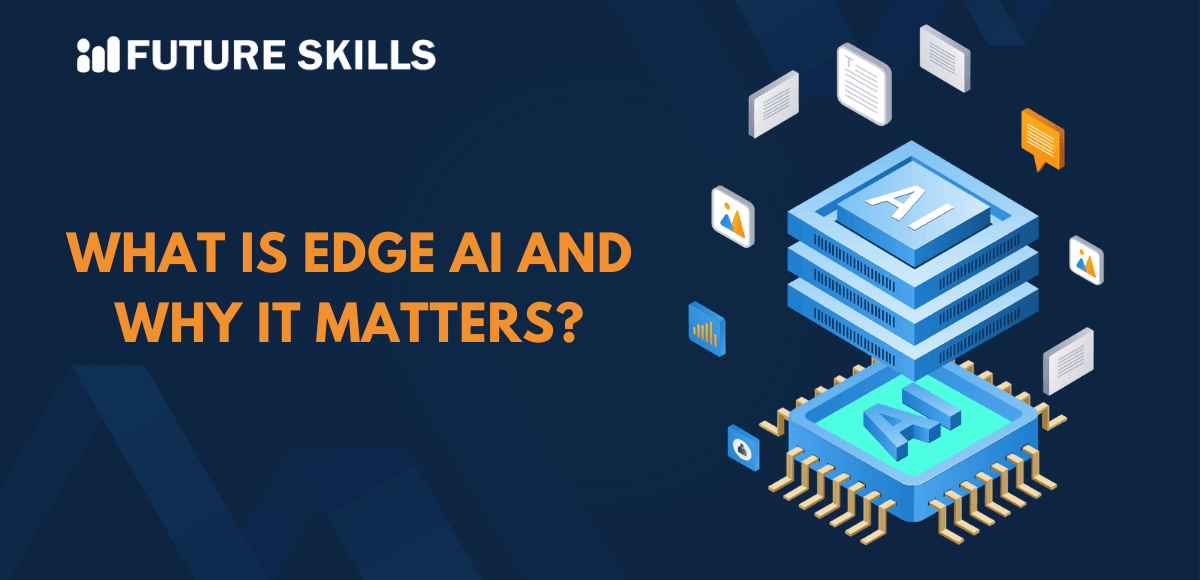

The evolution of smart technology with the introduction of edge computing has initiated major shifts no one had ever imagined. You are here looking for a detailed guide on edge AI explained for beginners because the time of edge AI is finally here. Till now, the only approach to make a smart device involved creating a terminal connected to a distant server. However, that equation has changed, and now intelligence has come closer to users with the power of edge AI.
You can clearly see that adopting edge AI is not about accessing intelligence in the smartphone in your pocket, the smartwatch on your wrist or the industrial robot working on the factory floor. Edge AI presents huge potential with continuously increasing volume of data at the edge and number of edge devices. Most important of all, businesses cannot ignore the financial benefits of embracing edge AI. You should learn about edge AI and how it enhances access to artificial intelligence beyond the cloud.
Become a certified AI expert with our most popular AI Certification Course and leverage the power of AI in any workspace.
Meaning of Edge AI Explained in Simple Terms
Edge AI represents the combination of artificial intelligence algorithms with edge computing. You can also think of edge AI as a derivative of the edge computing concept. Most of the answers to “What is edge AI and how does it work?” point at how edge computing involves processing data at the network’s edge. The edge could be present in the local server or the device itself rather than the cloud.
Most of the work in traditional AI requires significant computational resources, for which AI processing takes place in the cloud. Edge AI presents a significant change by facilitating AI processing on the device itself, including smartphones, industrial sensors, and cameras. The combination of edge computing and AI enables data collection at or in proximity of physical locations.
The best thing about edge AI is that it reduces the delay in responses by AI systems. Edge AI enables data processing within milliseconds and can provide responses in real-time without depending on internet connection. AI algorithms process data closer to the device location and also ensure enhanced data security as sensitive data stays on the edge.
Differences between Edge AI, Cloud AI and Distributed AI
The primary goal of artificial intelligence revolves around empowering computers to collect data and process it to generate results at par with human intelligence. At the same time, edge AI examples showcase that new and efficient approaches can outperform traditional approaches for using AI.
-
Edge AI vs. Cloud AI
The prominent difference between edge AI and cloud AI is the approach for deploying machine learning models. Traditional AI infrastructure relies a lot on cloud resources where data goes to remote servers for processing. The cloud-based approach creates problems with latency, constant dependence on the internet and significant security concerns.
On the contrary, edge AI works by processing data directly on the devices, such as IoT sensors and smartphones. As a result, it can ensure significantly lower latency and faster real-time responses. Edge AI also helps in improving data privacy by ensuring that information stays on the device. It plays a major role in reducing bandwidth usage, thereby serving as the best fit for applications with limited internet accessibility.
-
Edge AI vs. Distributed AI
Distributed AI is also an innovative approach to deploying artificial intelligence with the best of traditional AI and edge AI. The biggest highlight of distributed AI is the fact that it runs algorithms on multiple interconnected systems, including central servers and edge devices. Distributed AI divides tasks among different machines or devices with each component working on specific aspects of a problem.
You must know that distributed processing brings more power to data processing. As a result, distributed AI can offer more room for scalability than edge AI. However, distributed AI also comes with huge challenges in terms of complexity, overall privacy and latency.
Explore the implications of supervised, unsupervised, and reinforcement learning in diverse real-world use cases with Machine Learning Essentials Course
What are the Real-World Applications of Edge AI?
Edge AI offers the most efficient solution for local processing of AI tasks by avoiding the need for extra resources to send data to remote servers. Analyzing data closer to the source with edge AI ensures that you get faster responses without depending on bandwidth. This is the only reason for which edge AI applications in various sectors provide more room for productivity. Understanding the use cases of edge AI in different industries will help you figure out how it delivers a promising alternative for the future of AI.
-
Health and Fitness Tracking Wearables
The fitness trackers and smartwatches you use to monitor your physical activity and health patterns use edge AI. These devices leverage simple machine learning models directly on the device that analyze patterns and insights. As a result, the devices can provide instant alerts for any irregularities. Edge AI has also emerged as a promising solution for remote patient monitoring at home and sending real-time alerts to healthcare professionals.
-
Smart Homes
Voice assistants serve as a vital component in every smart home, helping you control music, lights and the thermostat. Edge AI helps virtual assistants process your voice commands locally and help in reducing latency alongside improving privacy. Security systems and energy management devices also use edge AI to learn different patterns and take relevant actions in event of suspicious activity.
-
Autonomous Vehicles
Autonomous vehicles also represent another promising use case of edge AI that will transform many lives worldwide. Edge AI serves as a powerful tool for real-time decision-making, especially in environments without a stable internet connection. Autonomous vehicles can rely on edge AI for navigation, object recognition and detecting obstacles in real-time as data processing happens directly on the vehicle.
-
Manufacturing and Predictive Maintenance
The list of applications of edge AI will be incomplete without mentioning predictive maintenance. Industrial sensors built for edge AI can defect issues in the manufacturing process, such as packaging errors, with more accuracy. In addition, edge AI also supports analysis of sensor data to monitor factory equipment and machinery for potential defects. Proactive detection of anomalies helps in preparing predictive maintenance schedules and avoiding unwanted downtime in manufacturing processes.
Discover the best techniques for using AI to transform your business with our AI for Business Course. Enroll now!
How is Edge AI a Better Approach to AI?
The blend of artificial intelligence and edge computing with edge AI brings many new benefits to the table. Edge AI brings high-performance computing capabilities directly to the edge or the devices. Data processing on devices in real-time ensures freedom from depending on connectivity and integration between systems. Learning about the benefits of edge AI projects will help you understand why it is gradually becoming more popular.
-
Reduced Power Consumption
The foremost advantage of using edge AI is the reduction in power use as local data processing saves energy costs. In addition, running AI algorithms at the edge requires significantly lesser power than traditional cloud-based approaches.
-
Enhanced Privacy and Security
Edge AI also reduces the risk of exposure of sensitive data as data is processed directly on the edge devices. Every edge AI system prioritizes data transfer by filtering redundant or unwanted data and ensures data processing and storage on the edge network.
-
Better Scalability
The next crucial benefit of edge AI is the flexibility for scaling up edge AI systems with cloud-based platforms and native edge capability on OEM equipment.
-
Lesser Bandwidth and Latency
Edge AI reduces the amount of data that you have to send to the cloud, thereby decreasing the costs. It facilitates data processing, analysis and storage directly on the edge device rather than relying solely on the cloud. As a result, edge AI also reduces the time required to respond to user requests.
Final Thoughts
Edge AI represents a paradigm shift in the AI landscape by combining artificial intelligence with edge computing. The biggest advantage of edge AI explained in simple words draws attention towards how it makes AI faster. The working of edge AI involves running AI algorithms directly on the devices on the edge. As a result, devices don’t have to send data to distant servers and wait for responses. Edge AI also reduces dependency on bandwidth, thereby facilitating better performance in areas where internet connectivity is not stable. Learn more about edge AI and its capabilities now.
FAQs
What is edge AI and how does it differ from cloud AI?
Edge AI represents a new approach to deploying AI directly on the edge or devices, such as smartphones, sensors and IoT devices. It is different from cloud AI that depends on sending data to remote servers for processing. While cloud AI delivers more power, it has to struggle with latency issues. Edge AI offers significantly lower latency and enhanced data privacy alongside assurance of functionality in environments with limited internet connectivity.
How does edge computing differ from cloud computing for AI?
Edge computing for AI involves processing data locally on devices to ensure immediate and low-latency responses. Cloud computing for AI involves sending data to remote servers in data centers for advanced training and large-scale data analysis. Therefore, edge computing for AI is a reliable choice for real-time applications. Cloud computing is an ideal choice for AI when the use cases demand complex analytics.
How do edge AI devices improve real-time data processing?
Edge AI devices improve real-time data processing through running machine learning algorithms directly on the local devices rather than sending data to the cloud. With this approach, edge AI devices can reduce latency and decrease bandwidth usage. Most important of all, edge AI does not depend solely on internet connectivity and can facilitate instant decision-making in critical applications.
Where can I find online training for AI developer certification?
You can find online training for AI developer certification on Future Skills Academy. It is a comprehensive platform for every learner who wants to build their career in artificial intelligence. Future Skills Academy offers a collection of self-paced and comprehensive training courses on different concepts in the AI space. Learners can also find accredited AI certification courses on the platform to improve their professional understanding of artificial intelligence.
About Author

James Mitchell is a seasoned technology writer and industry expert with a passion for exploring the latest advancements in artificial intelligence, machine learning, and emerging technologies. With a knack for simplifying complex concepts, James brings a wealth of knowledge and insight to his articles, helping readers stay informed and inspired in the ever-evolving world of tech.