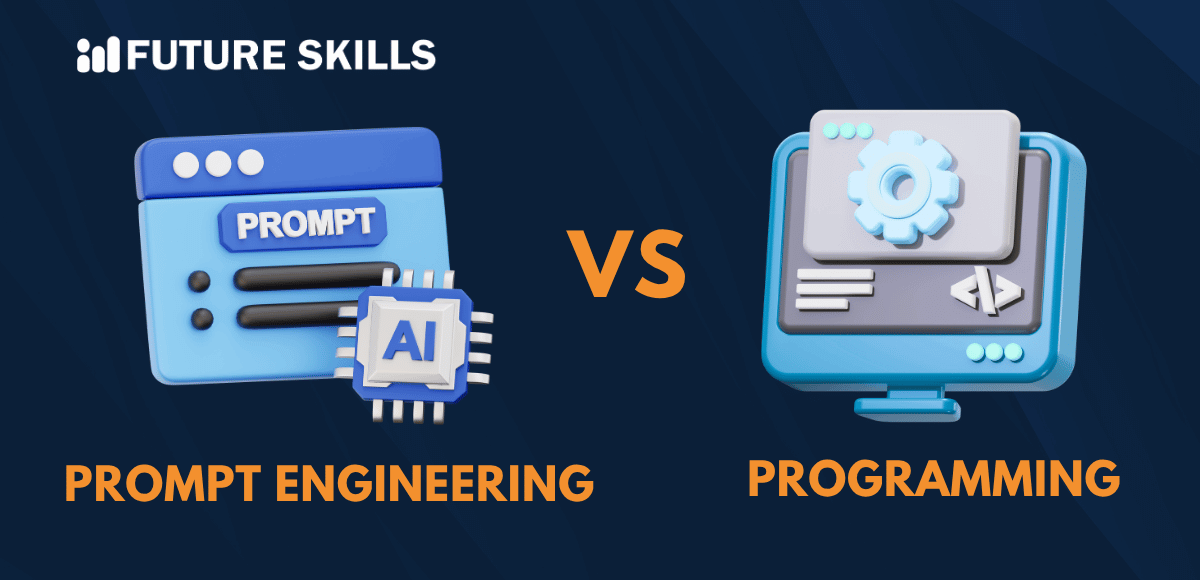

The technical landscape has been evolving rapidly. Concepts such as prompt engineering and programming have become increasingly common today. You need to know the difference between these concepts if you want to explore novel technologies at an in-depth level. Both conventional programming and prompt engineering serve different purposes.
On the surface, prompt engineering may seem quite simple. This is because it may seem like typing a set of instructions in plain English. However, the underlying dynamics of prompt engineering are not as simple as one may think. Similarly, traditional programming is much more than writing code, as it involves the holistic process of problem-solving relating to designing, testing, and debugging. It is the right time to understand: What is the difference between prompt engineering and programming?
Want to build a bright career in AI as a Certified Prompt Engineer? Enroll now in our new accredited Certified Prompt Engineering Expert (CPEE)™ Certification.
What is Prompt Engineering?
Before looking at prompt engineering vs programming, you need to have a clear understanding of these concepts. Prompt engineering refers to the process of designing, framing, and refining instructions in order to guide generative AI models. The purpose of these models is to help them generate the desired results.
Prompt engineering involves the use of clear language and exact formatting. You may sometimes also have to use examples for the purpose of communicating a specific task to an Artificial Intelligence model. You can consider prompt engineering as an art that helps to improve the accuracy, relevance, and overall quality of the response generated by AI.
What is Programming?
Programming refers to the process of writing a series of instructions or code. These instructions or code tell a computer system what it needs to do in order to perform a certain task. The code that is written in programming is written in a technical programming language. Some of the most popular programming languages are Python, Java, C++, and many more.
The Programming language is the language that can be understood by a computer system. Through proper programming, it is possible to ensure that a computer can execute a function such as solving problems, building applications, and creating software solutions. Now that you have an insight into programming as well as prompt engineering, it is time to look at: What is the difference between prompt engineering and programming?
Learn how ChatGPT and AI can transform your career and boost your productivity with the free ChatGPT and AI Fundamentals Course.
Major Difference Between Prompt Engineering vs. Programming
Now that you have clarity in the concepts of prompt engineering and programming, it is time to dive deeper and discuss their differences. It is fundamental for not only developers but for everyone to know the difference between prompt engineering and programming. Some of the main differences are:
Technical Foundation
In the case of programming, the process relies on explicit logic and strict syntax. You can also rest assured about predictable behavior. Regardless of the programming language that you use, your instructions are broken down systematically and they are executed with high precision. When a programmer sets a condition or defines a function, the output is deterministic in nature. It is expected to behave in the same way unless no external state changes are made. The high precision is what makes programming highly reliable as well as testable.
Prompt engineering, on the other hand, interacts with probabilistic language models that have been trained using huge volumes of data. Such models are able to generate the most likely or probable next token on the basis of the given prompt by the users. Thus, the response is not a hard-core response. You need to remember that prompts can generate slightly different responses each time, so there exists some sort of randomness. This is a major difference when it comes to prompt engineering vs programming.
Semantics Versus Syntax
Traditional programming involves writing code where programmers need to adhere to formal syntax. A single misplaced bracket or an indentation error by the coder can lead to the breakage of a program. Developers depend on interpreters and compilers to ensure the correctness of their coding. Some developers may even rely on static analysis tools for the purpose of making sure that their code is accurate and precise in nature.
In the case of prompt engineering, the inputs given by users are in natural language. There is no need for a compiler in the context of prompt engineering. Users have to rely on the training of the model as well as its pattern recognition ability for the purpose of interpreting the instructions. You need to bear in mind that even slight variations in prompts or words may generate significantly different outputs. It is a key difference you need to remember when it comes to programming vs prompt engineering.
Testing and Debugging
In the case of conventional programming, when a program fails, developers have a number of options available to them. They may trace variables. They may even review logs or utilize breakpoints. Furthermore, unit tests can help in the validation of logic against the expected outputs. The fundamental reason for bugs could be inaccurate assumptions or syntax errors. After the bugs have been fixed, they remain in the fixed state.
The bugs are often fuzzy when it comes to prompt engineering. This is because an AI model may generate hallucinatory facts for a user. There may be other issues as well in the form of inconsistent formats or highly verbose output. If you wish to diagnose the issue, you need to rely on simplifying or clarifying the prompt to the model.
Use of Tools
Conventional programming involves the use of mature tools. Some of the common tools that developers may prefer to use are version control, compilers, and many more. They may also decide to use other available options, such as CI/CD systems, as well as test automation frameworks. Such tools can empower developers when it comes to building, testing, and deploying at scale.
The tools that are used by prompt engineers today are entirely different. Some of the tools that they may prefer to use include OpenPrompt, LangChain, and PromptLayer. OpenPrompt can be used in the case of reusable prompt templates. Similarly, LangChain is ideal for chaining prompts into workflows involving multi-step reasoning. You can use PromptLayer in order to manage prompt versions as well as logging output behavior. You need to take into account these diverse tools while talking about programming vs prompt engineering.
Level up your AI skills and embark on a journey to build a successful career in AI with our Certified AI Professional (CAIP)™ program.
Final Words
In the vast technical landscape, both prompt engineering and programming are considered to be integral concepts. Developers need to have a clear understanding of these concepts so that they can apply these approaches in the right place.
The main differences between prompt engineering and programming have been explained in a simplified manner. Some of the major differences arise in areas such as technical foundation, semantics versus syntax, testing and debugging, and the use of relevant tools. You need to understand these differences in order to apply these concepts accurately in the practical setting.

About Author

David Miller is a dedicated content writer and customer relationship specialist at Future Skills Academy. With a passion for technology, he specializes in crafting insightful articles on AI, machine learning, and deep learning. David's expertise lies in creating engaging content that educates and inspires readers, helping them stay updated on the latest trends and advancements in the tech industry.