
Large Language Models or LLMs have introduced a completely new perspective on mainstream use of AI in content creation and natural language understanding. Developers creating AI applications with LLMs have to think about the fine tuning vs. prompt engineering debate as it has many implications. Organizations should decide which approach will be the best fit for customization of their AI models before full-scale development.
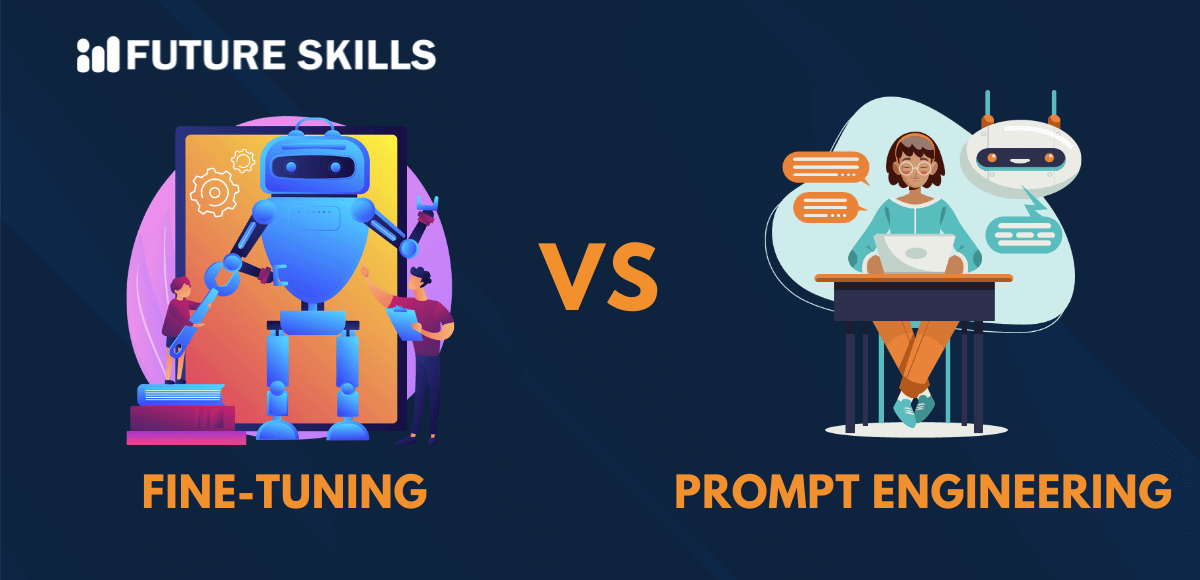
Prompt engineering and fine tuning are the two most notable techniques to customize language models. However, each customization approach is the ideal pick for specific scenarios and choosing the most relevant approach is important to achieve desired results. An overview of the differences between prompt engineering and fine tuning can help you make the right choice for your use case.
Become a job-ready AI professional with our accredited Prompt Engineering Certification Program. Learn the fundamentals and advanced techniques of prompt engineering in just four weeks.
Unraveling the First Point of Difference in Definitions
The easiest way to compare fine tuning with prompt engineering involves learning about their definitions. Many people think that the prompt engineering vs. fine tuning debate is all about differentiating between two loosely similar terms. You can identify the first difference between prompt engineering and fine tuning by learning about their definitions.
-
Understanding the Basics of Fine Tuning
Fine tuning focuses on training a general language model on a niche dataset again to make it more useful for a specialized domain or tasks. Most of the general LLMs are trained on large datasets from the internet and work effectively in general tasks that don’t require specialized knowledge for specific domains or tasks. Fine tuning changes the equation by bringing in specific datasets to retrain LLMs for niche tasks.
The process of fine tuning begins with creation of a custom labeled dataset. The specialized dataset is used to fine-tune a general language model and users can interact with the new model to obtain outputs. As a result, the fine-tuning process results in a new language model that has different functionalities from the original LLM.
-
Understanding the Basics of Prompt Engineering
The search for answers to “What is the difference between fine-tuning and prompt engineering?” will be incomplete without the definition of prompt engineering. It is a process in which you design and refine inputs for LLMs to obtain more accurate and relevant outputs. Prompt engineering does not involve retraining LLMs and focuses solely on how to query a model for obtaining the best results.
The prompt engineering process revolves around the output you want from the LLM. You provide a prompt to the general language model and review its output. Subsequently, you have to refine the prompt and feed it again to the LLM. The process will continue until you obtain the desired output from the LLM. Once you get the ideal prompt, you can save it as a system prompt that will be used during inference.
Enroll now in the Mastering Generative AI with LLMs Course to achieve specialization in using evaluation metrics to create reliable and accurate generative AI models.
Identifying the Notable Differences in a Fine Tuning vs. Prompt Engineering Comparison
The definitions of prompt engineering and fine tuning provide a general impression of the ideal scenarios to use them. You may think that fine tuning is the ideal approach to customize LLMs for niche tasks or specific domains. On the other hand, prompt engineering is an effective approach to obtain desired results from LLMs. However, you need to understand that the difference between fine tuning and prompt engineering also focuses on the following points.
-
Flexibility
Any organization worried about choosing fine tuning or prompt engineering for their AI models would also think about deployment flexibility. Fine-tuning involves retraining a model for a specific domain and making it work for another domain will require more resources. Therefore, fine-tuned language models offer limited flexibility and it is difficult to choose fine-tuning for scenarios that involve multiple niche tasks and demand rapid deployment.
On the other side of the debate, prompt engineering delivers more flexibility. You will only have to modify the prompt to deploy a language model for new tasks with prompt engineering. The flexibility of adapting LLMs for multiple tasks with prompt engineering allows you to use a single model without multiple retraining efforts.
-
Accuracy of Outcomes
The accuracy of outputs of LLMs is also one of the critical factors that developers take into account while customizing language models for AI applications. The fine tuning vs. prompt engineering comparison shows that fine tuning is tailored specifically to achieve higher accuracy in specialized tasks. Fine tuning involves direct optimization of a model’s parameters for niche tasks that require nuanced understanding and in-depth domain expertise.
The accuracy of outputs in fine-tuned models depends significantly on the diversity, size and relevance of dataset used in fine-tuning. You can get better results from fine tuning with high-quality datasets centered on specific tasks. On the contrary, the outputs in prompt engineering depend on the quality and structure of prompts. As a result, you will find lower accuracy in prompt engineering for tasks that require expertise in specific domains.
-
Requirement of Resources
The next point of concern for developers creating AI applications with LLMs is the amount of resources required for customization. You should know that fine-tuning requires significant resource investment as it needs substantial amount of computing resources and data for retraining. Developers should consider this as a trade-off for the benefits of enhanced accuracy and precision in LLM outputs.
Prompt engineering is the better choice for deploying AI models for different tasks with the use of minimal resources. Therefore, you can trust prompt engineering for scenarios where you need more flexibility and faster deployment, especially for applications with limited computational resources.
Enhance your AI skills and learn how to utilize the full power of AI with our Certified AI Professional (CAIP)™ course. Start your AI journey today!
-
Ethical Implications
The differences between prompt engineering and fine tuning should also account for the ethical considerations in each approach. Customization of LLMs can have wide ranging implications, such as privacy concerns, job displacement and propagation of misinformation. The prompt engineering vs. fine tuning debate shifts towards both sides in terms of ethical implications. The two techniques are equally capable of reinforcing biases existing in the training data.
Developers should follow transparency and responsible usage policies for effective mitigation of ethical risks. In fine tuning, you should pay attention to careful preparation of curated datasets and the ethical implications of outputs. You should also remember that fine-tuning offers the benefit of better control over the model training process and helps in reducing bias.
-
Use Cases
The most crucial point of comparison between prompt engineering and fine tuning is the type of use cases of each approach. Fine tuning is more suitable for LLMs that have to simulate human conversations and provide contextually relevant responses. Fine-tuned language models are also useful for accurate classification of text sentiment, customer feedback analysis and facilitating market research.
Prompt engineering is the ideal choice for LLM use cases where you want precise responses to user queries. You can rely on prompt engineering for generating articles, product descriptions and stories according to specific descriptions. Prompt engineering also makes LLMs provide answers to different queries with accuracy according to the given prompts, thereby improving information retrieval.
Final Thoughts
Prompt engineering and fine tuning are the two pillars that will hold the future of generative AI. Developers caught in the fine tuning vs. prompt engineering comparison have to choose the ideal customization approach according to the use case. You can pick fine-tuning when you have specialized tasks at hand and need domain expertise in LLMs. On the other hand, prompt engineering is more useful in use cases that require more flexibility and demand faster deployment. Learn more about prompt engineering and fine tuning with comprehensive training resources now.
FAQs
Is a fine tuning certification more valuable than prompt engineering certification for AI developers?
No, there is no specific reason to believe that a fine tuning certification is more valuable than a prompt engineering certification. The Certified Prompt Engineering Expert (CPEE)™ certification program by Future Skills Academy serves as an ideal resource for AI developers to obtain the desired output from LLMs.
What is the difference between fine-tuning and prompt engineering?
Fine-tuning is all about retraining a language model to make it work for specialized tasks that require domain expertise. On the other hand, prompt engineering is about creating the right questions that will extract the desired outputs from LLMs.
When should I fine-tune an AI model instead of prompting?
You should use fine-tuning instead of prompting in use cases that require specialized expertise, such as pattern-based tasks or complex multi-step tasks. Fine-tuning offers more control over the model outputs and the training process to reduce the risks of bias.
About Author

David Miller is a dedicated content writer and customer relationship specialist at Future Skills Academy. With a passion for technology, he specializes in crafting insightful articles on AI, machine learning, and deep learning. David's expertise lies in creating engaging content that educates and inspires readers, helping them stay updated on the latest trends and advancements in the tech industry.