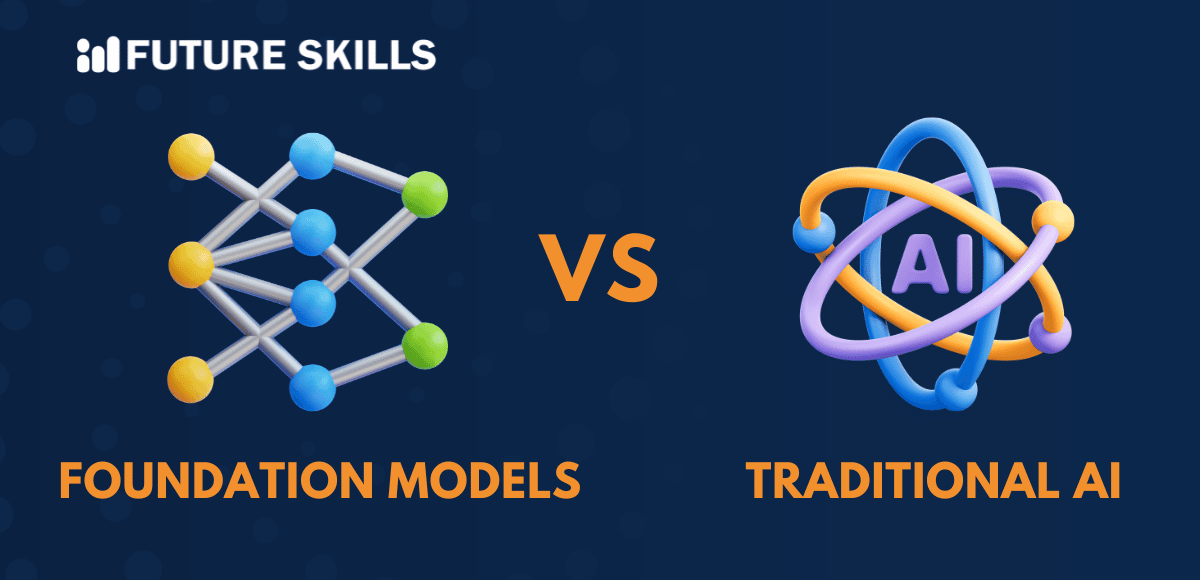

The rapid and massive shifts in the AI landscape seem to be happening in the blink of an eye. You have come a long way from AI systems recommending movies on Netflix to AI helping you debug code and paint masterpieces. This is where you need to understand the difference between foundation models and traditional AI models and their capabilities. The transition from traditional AI models to foundation models marks a significant turning point in the definition of structure of AI models.
- HTF Market Intelligence points out that the global foundation models market will have a capitalization of almost $125 billion by 2033 (Source).
- According to IDC, almost 80% of foundation models used in production-grade use cases will have multimodal capabilities by 2028 (Source).
The shift towards foundation models is not all about making AI faster or more accurate. As a matter of fact, the growing interest in foundation models indicates that the focus is now on building models that can do almost anything rather than being limited to specific tasks. Understanding the differences between foundation models and traditional models will help you find out why the AI landscape is gradually focusing more on foundation models.
Embark on a transformative journey into AI, unlocking career-boosting superpowers through our Certified AI Professional (CAIP)™ Certification program.
Definition of Foundation Models and Traditional AI Models
Many people will assume that foundation models are the ones that came first and established the groundwork for the AI landscape you see today. Most of the answers to “What is the difference between foundation model and traditional AI?” will point to the fact that traditional AI systems have been used for decades. Foundation models have emerged recently and show proof of what innovation has led to in the larger AI landscape.
-
Traditional AI
The biggest highlight of traditional AI is the narrow focus with which it operates. Traditional AI models have been developed with the objective of accomplishing specific tasks. If you create a model to identify dogs, then it will be completely useless if you ask it to play checkers or translate a paragraph.
The training of traditional AI models revolves around specific tasks and relies on narrow, labeled datasets to perform one function. As a result, you cannot expect traditional AI models to showcase adaptability as they will need retraining from scratch to work on different tasks. The spam filters in your email are the best examples of traditional AI applications.
-
Foundation AI
Foundation models are sophisticated and large deep learning neural networks that use massive datasets for training. You can think of them as huge ‘base’ models that learn underlying patterns in images, language or logic rather than learning one specific task. The first difference in foundation models vs. traditional AI models becomes clearly visible in the diversity of datasets used for training foundation models. This clearly indicates that foundation models are more adaptable than traditional AI models.
One of the distinctive highlights of foundation models is the fact that you can use one to build AI models for new applications. Data scientists and developers don’t have to retrain foundation models from scratch for new applications. With the help of fine-tuning and effective prompting, you can make foundation models perform different tasks. The notable examples of foundation models are GPT, Claude, and Google Gemini.
Build ChatGPT skills and take the first step to becoming superhuman with our free ChatGPT and AI fundamental Course
Unraveling the Difference between Foundation Models and Traditional AI Models
The search for differences between traditional and foundation AI models may be confusing for many beginners. From the outset, both the terms seem similar and indicate that they represent the models which have traditionally established the foundations of AI. However, the definition of foundation models and traditional AI models reveal a lot about the differences between them. You should dive deeper into other points of comparison that separate foundation models from traditional AI models.
-
Data Used for Training
The first difference between traditional and a foundation AI model is visible in the scale of data used for their training. The traditional AI models vs. foundation models debate showcases how traditional models rely on task-specific datasets. Traditional models use fine-tuning in the training process for optimizing performance in the specific dataset. In most of the cases, traditional models depend on carefully labeled datasets.
Foundation models are different as they are trained on large and diverse datasets. The example of GPT series of models by OpenAI clearly showcase the difference between the scale of data used for training foundation models and traditional AI models. The GPT series models use massive datasets with billions of parameters that help them perform multiple tasks across various domains. As a result, it is easier to generalize a foundation model for a wide range of tasks. Foundation models work with unsupervised training and don’t depend on data with explicit labels.
-
Design and Architecture
The next prominent point of comparison between traditional and foundation models revolves around their design and architecture. Traditional AI model design focuses on completing a specific task, as you can notice in rule-based systems or classic machine learning algorithms. The architecture of traditional AI models and systems has a narrow focus and is optimized for tasks like speech recognition, language translation, and image recognition.
On the other side of the spectrum, foundation models follow an innovative design with emphasis on training with huge and diverse datasets. The unique design of foundation models makes them capable of handling multiple tasks. You will notice that the typical architecture of foundation models follows the transformer-based architecture, like the one used in GPT. The architecture of foundation models makes them capable of general-purpose tasks. However, you can also fine-tune foundation models after pre-training to work on specific tasks.
Explore the implications of supervised, unsupervised, and reinforcement learning in diverse real-world use cases with Machine Learning Essentials Course
-
Practical Applications
You cannot complete a comparison between foundation and traditional AI models without focusing on their practical applications. The difference between foundation models and traditional AI models is clearly visible in the fact that traditional AI is ideal for task-specific accuracy. Traditional AI models are more useful in applications where you have a clearly defined scope for the problem you want to solve. The notable examples of practical applications of traditional AI models include image recognition, recommendation systems and fraud detection.
Foundation models are more suitable for open-ended tasks that require multitasking, creativity, and reasoning. You can come across many foundation models grabbing headlines in applications involving code development, natural language processing, and content generation. One of the notable examples of practical applications of foundation models is seen in Copilot that helps developers in writing code. The scope of practical applications of foundation models is growing with new use cases emerging across different domains.
-
Flexibility for Scaling
The list of differences between traditional models and foundation models also focuses on the element of scalability. Traditional AI systems are less flexible when it comes to scalability because they are inherently trained for specific tasks. The process of scaling traditional AI systems for handling multiple tasks will require developing and training different models for each task. As a result, you will experience inefficiencies in the use of compute resources, engineering efforts, and data usage.
The foundation models vs. traditional AI models debate turns in favor of foundation models in terms of scalability. Foundation models are designed for horizontal scalability, implying flexibility for expanding their architecture by adding more layers, data and parameters. You can take the example of the GPT series once again to notice how foundation models support scalability. The iterations of GPT models, including GPT-3 and GPT-4, come with dramatic improvements in their capabilities. The enhanced flexibility for scaling in foundation models makes them adaptable for new tasks without extensive retraining.
Final Thoughts
The comparison between foundation models and traditional models clearly establishes that foundation models are the future. The difference between foundation models and traditional AI models revolves significantly on their ability to manage different tasks. Foundation models use their training on massive and diverse datasets to adapt to different tasks while traditional AI models focus on specific tasks. However, traditional AI models outperform foundation models in applications where task-specific accuracy is paramount. Learn more about foundation models and traditional AI models to understand them better.
FAQs
What are the main differences between foundation models and traditional AI models?
The biggest difference between foundation models and traditional AI models is the fact that traditional models have a narrow focus. Foundation models can perform different tasks across multiple domains with their training on massive and diverse datasets. Traditional models follow rules-based architecture while foundation models rely on transformer-based architecture.
How do foundation models improve natural language processing over traditional AI models?
Foundation models can improve natural language processing as compared to traditional AI models by leveraging a strong and versatile pre-trained foundation. By learning from massive datasets with unlabeled data, foundation models can achieve superior and context-aware performance in different applications.
How can I enroll in an AI certification course from a leading provider?
You can enroll in the Certified AI Professional (CAIP)™ certification program by Future Skills Academy, a leading provider of professional AI training courses and certifications. The enrollment process is extremely simple and involves few steps. You can visit the official page of the certification and click on ‘Enroll Now’. In the next page, you can fill your details in the designated boxes and complete the payment to enroll in the certification.
About Author

James Mitchell is a seasoned technology writer and industry expert with a passion for exploring the latest advancements in artificial intelligence, machine learning, and emerging technologies. With a knack for simplifying complex concepts, James brings a wealth of knowledge and insight to his articles, helping readers stay informed and inspired in the ever-evolving world of tech.