
Agentic AI has emerged as the teammate who can work tirelessly and learn continuously while adapting to your needs. AI agents create new possibilities for end-to-end digital transformation across industries with their abilities for observing, reasoning, planning, and acting independently. The curiosity to learn about AI agent architecture is growing as agents streamline processes, draw new insights, and complement human potential in many ways.
- The global AI agents market is likely to achieve the size of over $52 billion by 2030 at a CAGR of 45% (Source).
- Adoption of multi-agent systems in enterprise environments increased 327% in four months (Source).
- 40% of AI agent projects will be shelved by the end of 2027, primarily due to lack of clear business value and risk controls (Source).
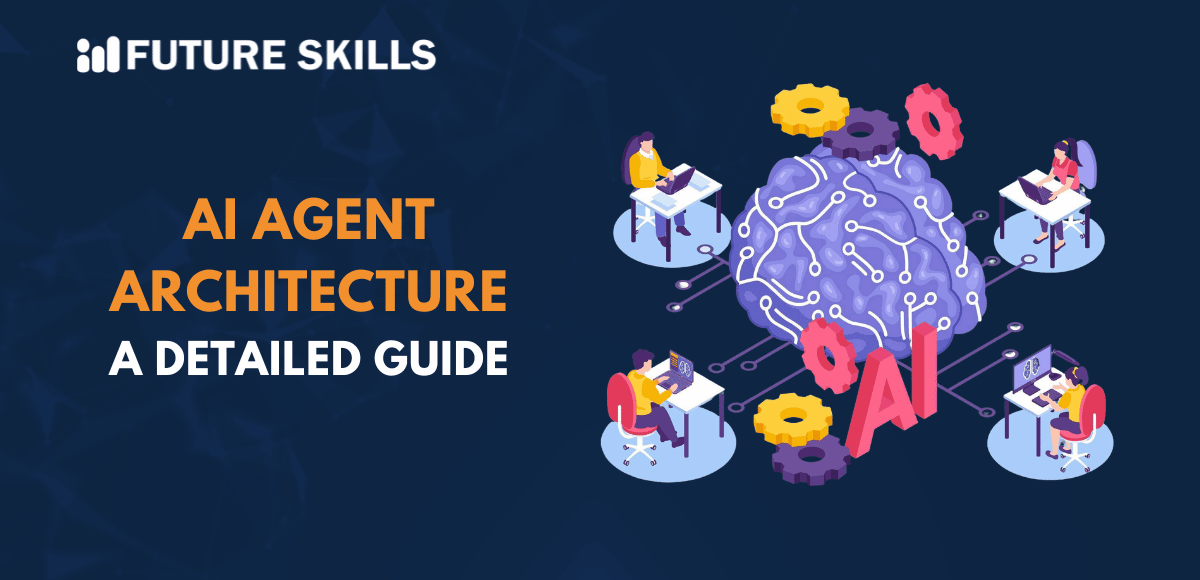
AI agents have become an integral component in enterprise automation, capable of driving intelligent copilots and autonomous workflows. The capabilities of AI agents for intelligent automation come from a structured architecture tailored for information processing, making decisions, and acting with caution in complex environments. You should use an overview of the different components in architecture of AI agents to figure out how agents work and how to use them to your advantage.
Gain in-demand skills to manage agentic AI workflows across the full AI agent lifecycle with the Certified AI Agents Manager (CAIAM)™ Certification
Understanding AI Agent Architecture and How It Works
Agentic AI architecture represents the complete stack of components that transforms LLMs into autonomous systems that can plan, think, and act towards the assigned goal. You should also know that AI voice agent architecture or general agentic architecture focuses on executing goals through multiple iterations. AI agents call the language model in a loop and feed the result of every tool call to the model while moving closer to their goal.
What does the loop in agentic AI architecture look like? The answer will help you get a better idea about how the architecture of AI agents works in different phases.
-
Observation
The first step in the loop involves the agent receiving input, either in the form of a user request, scheduled trigger or result of the last tool call by the agent.
-
Reasoning
Once the agent receives the input, the underlying LLM will decide the next action. The action can be a direct response, calling a tool, asking a follow-up question or breaking down the task into smaller steps.
-
Action
After determining what to do, the agent will call an external tool, primarily through APIs. AI agents can use tool calls for SQL queries, sending HTTP request or invoking other agents.
-
Updating the State
The outcome of the loop is added to the memory of the AI agent, and it serves as input for the next observation.
Level up your ChatGPT skills and kickstart your journey towards superhuman capabilities with Free ChatGPT and AI Fundamental Course.
Unraveling the Core Components in AI Agent Architecture
The architecture of AI agents empowers them to perceive information, think about it, and take relevant action followed by learning from the results. Every component in any AI agent architecture diagram manages a specific function, and together they help AI agents work on complex tasks involving multiple steps. Understanding the different layers or components in agentic architecture will help you figure out exactly how AI agents function independently.
1. Perception Layer
The working of every AI agent begins with the perception layer as it collects input from users or the external world and prepares it for the next layer. AI agents can take their input for the perception layer from various sources, including live API data, user prompts, uploaded documents and files, system logs, monitoring data, and database queries.
You will notice that the perception layer is the simplest in the case of basic agents where users type something and the agent receives the instruction. The perception layer also takes care of preprocessing the input data in more advanced systems. It is important to know that the effectiveness of the perception layer has a huge impact on downstream decisions of AI agents.
2. Reasoning Layer
The most crucial component in the architecture of any AI agent is their brain or the reasoning engine. Most of the AI agents you see today use LLMs as their reasoning engine while other systems combine decision trees, reinforcement learning, and rule-based logic for reasoning. Irrespective of the AI agent architecture patterns in the reasoning layer, it focuses primarily on receiving the input deciding what to do next.
The reasoning engine of an AI agent understands the goal assigned to the agent and breaks the goal into different steps before deciding what action it should take. You can see that the reasoning engine is the major difference between a reactive language model and an autonomous agent. While a generic chatbot will respond to your question, the reasoning engine generates a structured plan to achieve your goals.
3. Memory Layer
AI agents without memory will have to start from scratch after every loop. You cannot ask someone to build something complex when you are wiping their memory after every action. The memory layer solves this problem in AI agents and helps an agent in maintaining context, tracking its progress, and carrying forward information across different steps and sessions.
Most of the agentic AI architectures use two types of memory, short-term and long-term memory. Short-term memory exists within a single session and helps in tracking what has happened in the current task, including the tools called, outputs, and next step. On the other hand, long-term memory exists across all sessions and stores user preferences, domain knowledge, historical patterns, and past outcomes. The long-term memory in an AI agent plays a pivotal role in improving agent performance in specific tasks over time.
Learn how to use AI and generative AI skills in your business or work with our AI for Everyone Free Course. Enroll now!
4. Tooling and Action Layer
The actual work of an AI agent happens in the tool and action layer where it takes relevant actions to achieve its goal. AI agents can connect with external systems with the help of tool and action layer and do more than just generate text. The utility of the tool and action layer in AI agent architecture empowers agents to query databases, call APIs, trigger automated workflows, write and execute code, and interact with web browsers.
You take away the tool and action layer from an AI agent, and it becomes just another AI-powered content generator. This layer enables the agent to become an operator who takes output from the reasoning layer to do something meaningful. At the same time, the tooling and action layer also introduces risks due to connection with external systems. Therefore, the orchestration layer deserves effective access controls and human oversight.
5. Orchestration Layer
Single-agent systems work with one agent who works on the specific set of instructions provided to them with constant workflows. On the other hand, complex multi-agent systems require someone to manage the interactions between different agents. You can describe the orchestration layer as the coordinator in agentic systems with multiple specialized agents. The orchestration layer determines the order in which agents should take actions and manages multiple tools running in parallel.
Complex agentic systems rely on a dedicated orchestration layer to ensure effective coordination between different agents. Without the orchestration layer, managing multi-agent systems becomes more unpredictable, and you will face issues in debugging. The orchestration layer is the same as a project manager who looks after the work done by other layers. In simple words, the orchestration layer ensures that everything is in place and is essential for reliable production systems.
6. Feedback Loop
The feedback loop is also one of the critical components in the architecture of AI agents. You can pick any example of AI voice agent architecture and discover that the feedback loop ensures continuous improvement. After the agent takes a specific action, the feedback loop checks whether the agent achieved its goal. If the agent has completed the task, then the feedback loop will store the outcome for future reference.
In scenarios where the agent fails to achieve its goal, it has to adjust its actions. The agent can retry with a different approach, flag for review or escalate to a human. Advanced agentic systems use the feedback loop to ensure continuous learning with the help of signals. The signals can be in the form of task completion rates and human ratings. AI agents use the feedback to update their behavior over time and transform into continuously learning systems.
Learn artificial intelligence with our structured AI Certification Course and explore new career opportunities.
Final Thoughts
The insights on each layer in AI agent architecture showcase that agentic AI moves beyond the traditional language models. As a matter of fact, agentic architecture transforms LLMs into autonomous systems that can think, plan, and act without intervention. The architecture of AI agents empowers them to perceive inputs and determine the ideal course of action. In addition, agentic AI architecture also includes layers to retain memory and use external tools to achieve goals. With the growing adoption of AI agents, more people want to figure out the magic behind these autonomous systems. Learn more about AI agents and discover how they work now.
FAQs
What are the fundamental components of an AI agent’s architecture?
The fundamental components of an AI agent’s architecture include perception layer, reasoning engine, and memory layer. AI agents also include tool and action layer, orchestration layer, and the feedback loop in their architecture. Perception layer takes the input, and the reasoning engine finds out what to do next. The memory layer retains memory of all interactions of the agent and the tool, and action layer defines tool usage.
How to choose AI agent architecture for customer service automation?
You can choose AI agent architecture for customer service automation by identifying your use cases. Matching the complexity of customer queries to the decision logic of the agentic system gives the perfect solution. The ideal approach will involve mapping your use cases in customer service automation to different AI agent architecture patterns.
Where to find AI agent architecture software providers?
You can find AI agent architecture software providers by exploring popular enterprise AI platforms or open-source frameworks. Popular enterprise agent builders like Kore.ai and Redis are the top choices to design AI agent architecture. You can also rely on open-source frameworks like CrewAI and LangChain to build AI agent architecture from scratch.
What are the leading professional certifications for AI agent system design?
The Certified AI Agents Manager (CAIAM)™ certification program by Future Skills Academy is the leading professional certification for AI agent system design. It provides a deep dive into architecture and components of agentic AI with comprehensive description of the agent frameworks ecosystem. You will also find detailed explanation of single-agent and multi-agent architectures in the certification course.
About Author

David Miller is a dedicated content writer and customer relationship specialist at Future Skills Academy. With a passion for technology, he specializes in crafting insightful articles on AI, machine learning, and deep learning. David's expertise lies in creating engaging content that educates and inspires readers, helping them stay updated on the latest trends and advancements in the tech industry.