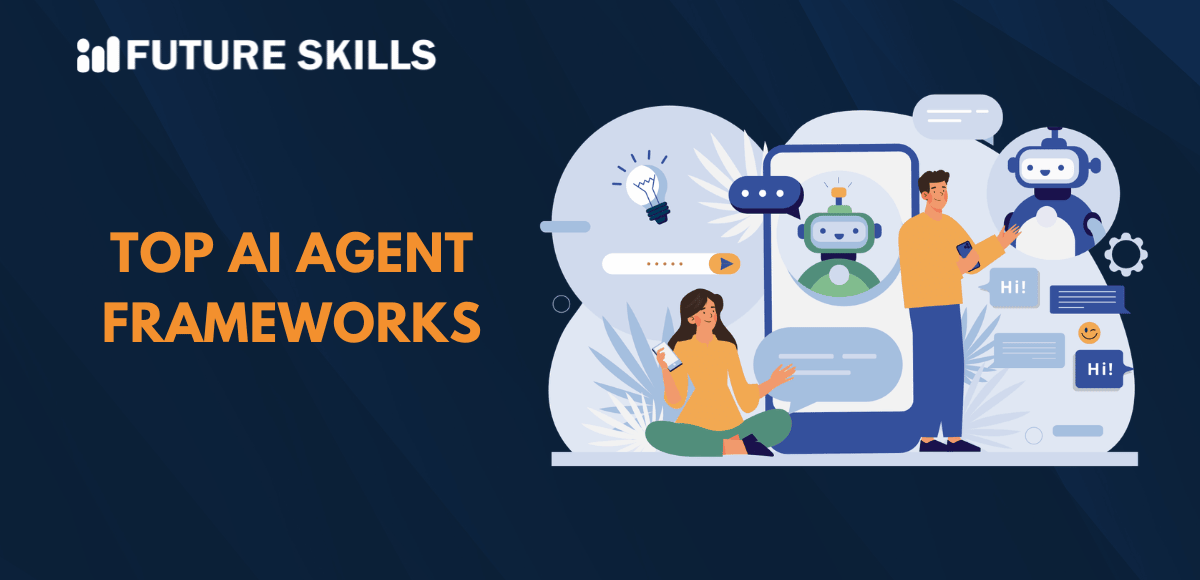

The era of AI systems responding to prompt interactions is gradually coming to an end with the rise of agentic AI. Artificial Intelligence agents have been transforming language models into autonomous systems that require minimal human interaction and can achieve the assigned goals. The best AI agent frameworks help developers build these autonomous agents for a wide range of use cases.
- The IDC FutureScape 2026 report showed that 45% of organizations will be managing AI agents at scale by 2030. (Source)
- A survey by McKinsey pointed out that 62% of organizations are trying new experiments with AI agents. (Source)
- The AI Agent Survey by PwC in 2025 revealed that 79% of senior executives in the survey had adopted AI agents and 66% of them achieved measurable value from agentic AI. (Source)
AI agent frameworks have become the most trusted tools to build AI agents, as they can help in managing the reasoning, collaboration, memory, and tool usage among multiple agents. With the growing number of AI agent frameworks available for developers, it is reasonable to have some doubts while choosing a framework for your next agentic AI project. Learning about the top agentic AI frameworks and their features will help you pick the best framework for your needs.
Gain in-demand skills to manage agentic AI workflows across the full AI agent lifecycle with the Certified AI Agents Manager (CAIAM)™ Certification
Understanding AI Agent Frameworks
AI agents showed that you can transform language models into autonomous software systems. The autonomous systems have capabilities for independent reasoning, setting goals, and performing tasks to achieve the desired goals of users. You can understand the best way to find answers to “Which is the best framework to build AI agents?” by learning what these frameworks do. Agentic AI frameworks offer the infrastructure required for developing, running, and managing AI agents at scale.
You will notice that every AI agent framework offers the following core capabilities.
-
Orchestration
AI agent frameworks control the sequence in which agents are arranged in a multi-agent system, how they coordinate with each other, and the permissions for collaboration between agents.
-
Memory
Agentic AI frameworks also define how agents can retain and retrieve information across different steps and sessions.
-
Tools
The utility of an AI agent framework also extends to defining the ways in which agents can interact with external systems, including databases or APIs.
You should know that a framework is not mandatory to build AI agents. On the contrary, agentic AI frameworks play a major role in ensuring that AI agents function reliably, offer security, and can deliver benefits of scalability. AI agent frameworks can help you transform experimental agentic builds into production-ready software systems.
Learn artificial intelligence with our structured AI Certification Course and explore new career opportunities.
Unraveling the Best AI Agent Frameworks in 2026
Many developers have one big question when it comes to AI agent frameworks: Should I pick an agentic AI framework or build a custom agentic system from scratch? You will need a curated AI agent frameworks list when you have to deal with complex orchestration patterns and need pre-built infrastructure. AI agent frameworks are must-haves when you need to build systems that are ready to scale and offer easier debugging. A list of the best agentic frameworks that you can find now will help in making the right decision for your next project.
1. LangChain
If you ask anyone about the most popular and commonly used agentic AI frameworks, the answer is likely to be LangChain. Since 2022, it is the ideal choice for every agentic AI developer as it offers a broader ecosystem of integrations. LangChain is the best framework to create prototypes for agentic AI systems, LLM-powered backend services, and chatbots with tool capabilities.
LangChain stands out as a widely used AI agent framework because it offers an accessible interface for almost every LLM. Even with the limitation of reduced control, LangChain is an ideal choice for enthusiasts and beginners who are exploring agentic systems for the first time. You can always trust LangChain for projects where speed and creativity take priority over the need to introduce stricter workflows.
2. LangGraph
The next big framework for AI agents runs on LangChain and offers the utility of graph-based orchestration. LangGraph is one of the top AI agent frameworks that you can rely on for production-grade agent systems. It offers explicit graphs instead of implicit chains, thereby offering better control over workflows. LangGraph also leverages interrupts to provide the assurance of seamless human-in-the-loop support.
The graph structure in LangGraph helps in creating deterministic workflows where debugging is easier with clear mapping of the interactions between agents and tools. Many critics point out that learning how to work with LangGraph can be complex due to requirements for designing the graph and explicit state management between nodes. However, effective understanding of these concepts will show that LangGraph is a powerful framework to build predictable agentic systems that work in your control.
3. Microsoft AutoGen 2.0
AutoGen is a popular open-source agentic framework by Microsoft and played a major role in redefining how agents collaborate with each other. In the 2.0 release, Microsoft Research has rebuilt the framework from scratch with async-first architecture and a modular runtime. The AutoGen 2.0 framework has also addressed many limitations that came with the original framework. With native async support, AutoGen 2.0 is the first choice for multi-agent workflows that require higher concurrency.
The modular runtime in AutoGen 2.0 is a huge production upgrade in the framework that complements the benefit of minimal orchestration overheads. Developers can also leverage the deep Azure OpenAI integration and Microsoft ecosystem integration to avoid the need for additional infrastructure. On top of it, AutoGen 2.0 also helps in designing stronger code generation and execution workflows.
Enroll in the world’s best Free AI Course and build a strong foundation. Explore new opportunities to pursue a career in AI.
4. CrewAI
The search for most popular agentic AI frameworks will be incomplete without including CrewAI in the list. Developers can rely on CrewAI to develop simple and highly structured multi-agent systems. The working of CrewAI is similar to that of AutoGen in how it designs AI agents as the members of a crew, and each agent takes on a clearly defined role.
CrewAI is one of the best AI agentic frameworks that aim to make multi-agent systems simpler, even for beginners in agentic AI. One of the distinct aspects of CrewAI is that it prioritizes simplicity and speed over production controls and deep memory. As a result, it serves as the ideal option for small teams and prototype design with a simpler learning curve.
5. OpenAI Agents SDK
OpenAI Agents SDK is also a prominent name among the most used agentic AI frameworks that came up with a recent platform upgrade in March 2026. It provides a native framework to develop agentic workflows on GPT models. The SDK provides abstraction for tool use, multi-step reasoning, and function calling in one clean API, which appears as a natural extension of the OpenAI ecosystem.
The best thing about OpenAI Agents SDK is that you don’t have to maintain the orchestration infrastructure. Developers can rely on this framework to define agent behavior and workflows without assembling agents from scratch. OpenAI takes care of orchestration, safety controls, memory management, and monitoring with strong multi-agent support. Therefore, Agents SDK is an appealing choice for teams that need production-ready agents quickly.
Final Thoughts
The list of best AI agent frameworks that you witnessed here clearly shows that every framework has different strengths. You should choose an AI agent framework according to your use case, infrastructure context, and team capabilities. It is also important to consider the constraints of your business, especially in terms of budget, while choosing agentic frameworks. Learn how to choose an AI agent framework and expand the chances of success of your agentic system now.
FAQs
What are the best AI agent frameworks for building autonomous software?
The best AI agent frameworks for building autonomous software come with capabilities to manage complex workflows and self-correcting reasoning loops. You will also notice that the best agentic AI frameworks also support multi-agent collaboration. The notable examples of AI agent frameworks for building autonomous software include LangGraph, AutoGen, and CrewAI.
How to choose an AI agent framework for enterprise applications?
You can choose an AI agent framework for enterprise applications by careful evaluation of frameworks and identifying your needs. It is important to check whether the framework fits your architectural, collaboration, and regulatory requirements. The biggest factors that you should look for in such cases include multi-agent communication, stateful workflows, governance, and integration maturity.
Where to find AI agent frameworks with strong community support?
The most successful way to find AI agent frameworks with strong community support involves browsing through GitHub repositories. You can also explore developer-centric platforms like Stack Overflow, active Discord servers, and Reddit for viable suggestions. AutoGen, CrewAI and LangGraph are the biggest AI agent frameworks with robust community support.
Where can I enroll in an accredited AI agent certification?
You can enroll in an accredited AI agent certification program at Future Skills Academy. The Certified AI Agents Manager (CAIAM)™ certification course by Future Skills Academy is a self-paced certification program for learners who want to work with agentic AI. It is a comprehensive learning resource that offers lessons on fundamentals of AI agents, their architecture, components and the larger agentic ecosystem. The certification also provides a reliable resource to acquire technical fluency in managing agentic systems.
About Author

David Miller is a dedicated content writer and customer relationship specialist at Future Skills Academy. With a passion for technology, he specializes in crafting insightful articles on AI, machine learning, and deep learning. David's expertise lies in creating engaging content that educates and inspires readers, helping them stay updated on the latest trends and advancements in the tech industry.