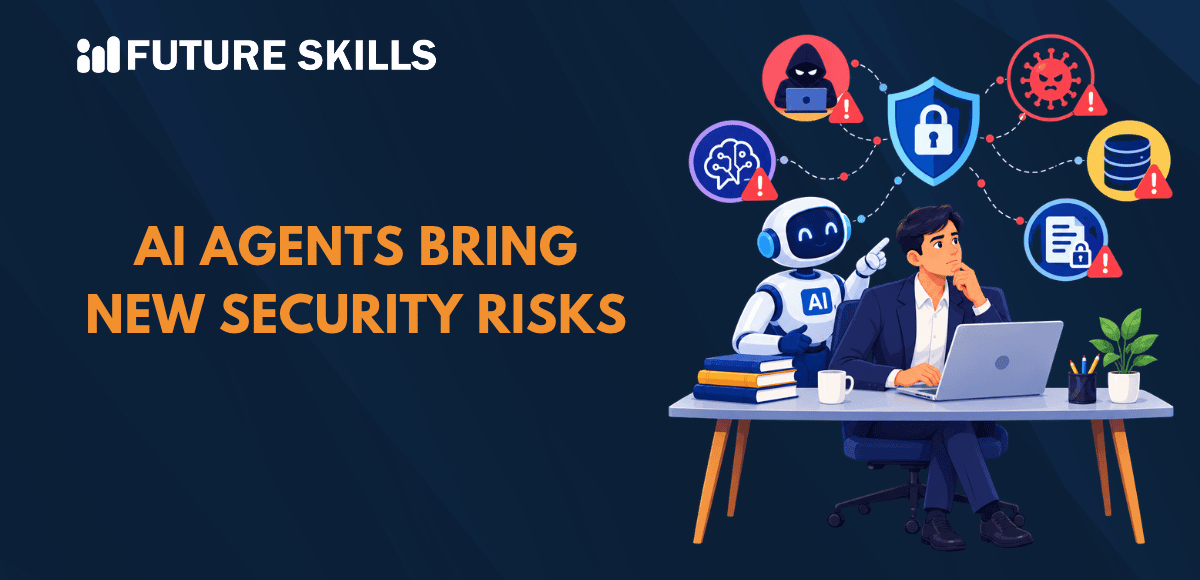

AI agents have already surpassed the trend of answering questions and are now easing a series of complex tasks. They are accessing business systems, managing sensitive data, and making decisions with limited human intervention. So, from automating your customer support to handling workflows and analyzing company data, such systems are becoming part of everyday business operations. However, greater autonomy gives rise to new security challenges that your business needs to understand.
In 2027, AI agent security will demand that your business look beyond conventional cyber threats. Further, you need to understand how intelligent systems can be manipulated, misused, or given excessive permissions. Some of the major AI agent security threats might include prompt injection, unauthorized data access, compromised tools, and poorly controlled agent action. So, understanding such risks early can help your business build safer workflows and strengthen access controls.
Gain in-demand skills to manage agentic AI workflows across the full AI agent lifecycle with the Certified AI Agents Manager (CAIAM)™ Certification
How do AI Agents Protect against Cyber Threats in Business Environments?
AI agents mainly protect against cyber threats when they function within a security framework that controls what they can access, which actions they can perform, and how they respond to malicious activities. Further, effective AI agent security combines traditional cybersecurity measures with controls curated for autonomous systems.
So, these factors can help your business minimize unauthorized access and prevent data exposure.
- Assign each agent a unique identity and grant access only to the resources it requires.
- Track agent actions, data access, API calls, and unusual activity to verify potential threats.
- Require authorization before agents perform high-impact actions, like transferring funds or changing sensitive records.
Agentic AI security can protect your business when such protection works together throughout the agent’s lifecycle. So, instead of depending on an individual security layer, organizations need to secure the agent’s instructions, data sources, connected tools, and actions.
- Least-privilege access limits the damage an agent can cause if its permissions are misused.
- Input validation and prompt-injection defenses help identify malicious data hidden in user prompts and documents.
- Audit logs and behavioral assessment help security teams investigate suspicious actions and respond to incidents.
Prepare yourself for the evolving challenges of Agentic AI security with Future Skills Academy’s industry-oriented certifications and courses. Build practical knowledge and understand responsible AI implementation.
Advance your career with the Certified AI Security Expert (CAISE)™ certification—master LLM security, adversarial machine learning, and advanced AI defense mechanisms to combat real-world AI risks with confidence.
List of Biggest AI Agent Security Risks Businesses Need to Prepare for in 2027
As businesses offer AI agents more autonomy, the potential consequences of a security failure become more critical. An agent with access to company data, internal applications, and external tools can generate risks that go beyond conventional software challenges. So, understanding such AI agents security risk can help organizations identify weak points and establish safeguards before deploying agents across important business functionalities.
1. Prompt Injection Attacks
This risk takes place when attackers manipulate your AI agent through malicious content hidden in prompts, documents, emails, and web pages. So, if the agent fails to recognize the untrusted content from authentic data, it might disclose sensitive information. So, you need to treat external content as potentially untrusted and implement validation, monitoring, and permission checks.
2. Excessive Permissions
AI agents generally need access to business applications to complete certain tasks. However, giving them more permission than necessary can increase the influence of a compromised agent. For example, an agent curated to summarize customer records should not automatically have permission to delete those records or make any changes to the financial information.
- You can apply the principle of least privilege by granting agents access only to the resources needed for their assigned tasks.
- Separate read and write permissions whenever possible or required.
- Get human approval for sensitive or irreversible actions.
2. Sensitive Data Exposure
Your AI agents might access confidential business documents, financial records, customer details, and employee data. So, if access controls are poorly configured, an agent could disclose the data in response and send it to an unauthorized destination. Such AI agents security risk becomes more significant when agents can retrieve data from multiple systems. Further, you should enforce data access policies and mask sensitive data where appropriate.
3. Compromised Tools and Integrations
AI agents frequently depend on plugins, APIs, databases, and third-party services to perform actions. So, if one such integration is incorrectly configured, attackers might exploit the connection to manipulate agent behavior or access protected systems. In fact, your legitimate tool can become dangerous when it accepts unsafe inputs.
4. Agent-to-Agent Security Risks
As your business might deploy multiple agents that collaborate on complex workflows, a compromised agent can potentially influence other agents. For example, one agent might pass manipulated data to another. So, such interactions make it harder to trace where a security failure originated.
5. Memory Poisoning
Some AI agents maintain memory or retrieve data from previous interactions to complete future tasks. So, if an attacker introduces misleading data or false information into such sources, the agent might depend on that content in later decisions.
6. Supply Chain and Third-party Model Risks
AI agents often depend upon external models, plugins, open-source frameworks, and third-party services. So, vulnerabilities in such components can introduce security weaknesses into otherwise well-protected systems. Further, changes to a model or dependency might also affect how an agent behaves, making ongoing assessment very critical.
Stay ahead of emerging AI agent security challenges with Future Skills Academy’s industry-focused courses. Build your skills to understand the changing pattern of AI threats.
What is the Purpose of AI Security Certification for Businesses?
Now you can fully answer what are the biggest security risks of AI agents in a detailed manner. So, let us understand the purpose of AI security certification for your business. An AI security certification helps professionals understand how to identify, assess, and handle security risks related to AI systems. Further, for businesses adopting autonomous agents, such knowledge is particularly valuable as agents can access sensitive data.
-
Get Acquainted with Emerging AI Security Threats
AI security training can help you identify threats like data leakage, prompt injection, model manipulation, and unauthorized agent actions. So, understanding such risks can allow your business to identify risks before attackers exploit your system.
-
Strengthen Data Protection Practices
AI agents might process confidential business data and customer records. So, proper certification can help you understand access controls, data privacy principles, and secure information handling to reduce the likelihood of unauthorized disclosure.
-
Integrate Secure AI Agent Permissions
Agents should have proper access to the applications, tools, and information needed for their tasks. Further, learning about identity management and permission boundaries can help your business limit the damage caused by compromised or misbehaving agents.
-
Strengthen Threat Monitoring Response
Certification can help security professionals develop the knowledge required to monitor agent behavior, investigate suspicious activities, and respond to security incidents. So, such capabilities are essential when multiple agents and integrations operate across business systems.
-
Improve AI Governance
Businesses require clear policies governing how AI systems access data, make decisions, and execute actions. Further, AI security training can help professionals understand governance frameworks, audit trails, accountability needs, and important regulatory requirements.
Conclusion
As businesses increasingly adopt autonomous AI systems, investing in AI agent security is necessary to safeguard sensitive data and maintain control over automated operations. So, with the right skills, security practices, and governance measures, your organization can easily prepare for emerging threats while using AI agents safely and responsibly.
FAQs
What are the best AI agent security platforms for enterprise use?
Some platforms that support enterprise AI security include Palo Alto Networks, Microsoft Defender, and IBM Guardium. Depending on the solution, they offer capabilities like threat detection, data protection, access control, and security assessment. So, you should evaluate their AI infrastructure, integration needs, etc.
What are the leading open-source frameworks for securing AI models?
Popular open-source tools and frameworks include NVIDIA NeMo Guardrails for controlling LLM interactions, Guardrails AI for validating model outputs, and LLM Guard for detecting potential threats like prompt injection and sensitive data exposure.
How can my business reduce AI agent security risks?
You can reduce AI agent security risks by enforcing least-privilege access, validating inputs, protecting sensitive data, and assessing agent activities. Further, you should test agents for prompt injection, secure third-party integrations, and maintain audit logs.
About Author

James Mitchell is a seasoned technology writer and industry expert with a passion for exploring the latest advancements in artificial intelligence, machine learning, and emerging technologies. With a knack for simplifying complex concepts, James brings a wealth of knowledge and insight to his articles, helping readers stay informed and inspired in the ever-evolving world of tech.