
Artificial intelligence is not limited to chatbots and predictive models. Nowadays, enterprises are using large language models to power applications that can understand context, generate content, assess information, and support complex business processes. McKinsey estimates that generative AI could add up to USD 2.6 trillion to USD 4.4 trillion in value each year. But only enterprises with the right architecture can capture much of it.
But deploying an LLM is only one part of creating an enterprise-grade AI system. Organizations also need the right set of infrastructure, data pipelines, model management, etc., to make such systems reliable. The next shift is toward enterprise AI architecture that can reason through tasks, use tools, interact with enterprise systems, and take actions with minimal human intervention.
Become a certified AI expert with our most popular AI Certification Course and leverage the power of AI in any workspace.
What is Enterprise AI Architecture?
Enterprise AI architecture is considered to be the technical structure that is leveraged to connect AI models with enterprise data, infrastructure, applications, security controls, and business processes. It offers the crucial layers through which an AI application gets information, processes it, and generates predictions. Further, it interacts with your business and produces valuable outcomes.
A standalone LLM application might simply send a prompt to a model and return its responses to the users. However, an enterprise AI system has many more responsibilities to handle.
- It might need to access internal documents, communicate with applications, and retrieve real business data.
- So, the architecture must account for how data enters the system.
- This is how models process it and how the resulting output is offered.
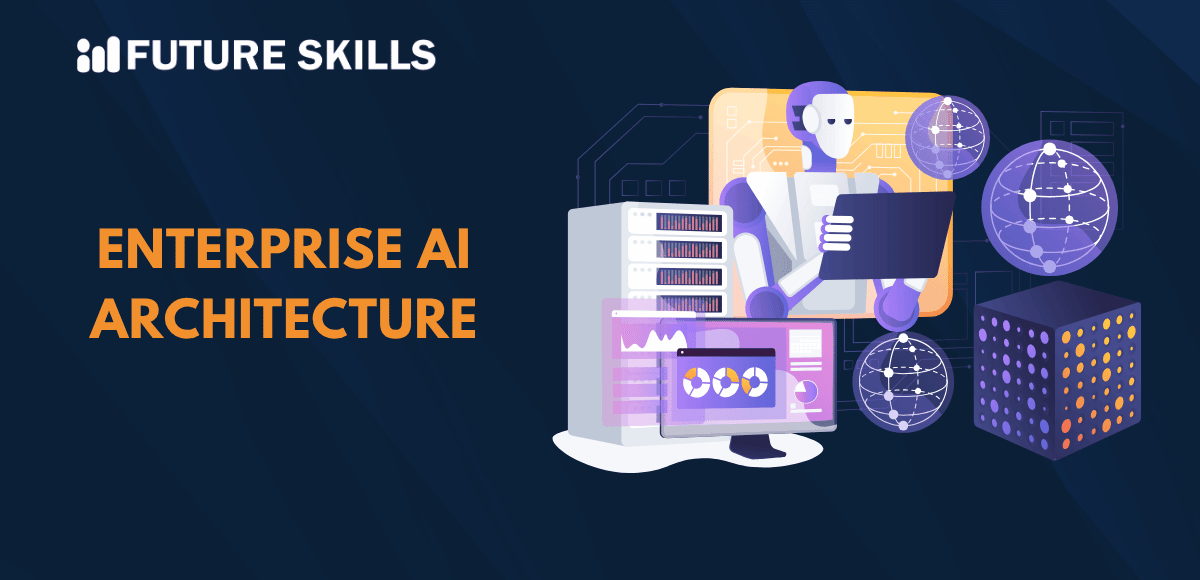
Enterprise AI architecture works by connecting your business data, AI models, knowledge retrieval, agents, and enterprise applications in a coordinated workflow. Each layer works for a specific function, allowing AI to process information and deliver useful results while operating within defined governance controls.
- The process begins with enterprise data from databases, documents, and internal knowledge sources.
- RAG retrieves necessary information from approved enterprise knowledge sources and provides it as context to the AI model.
- Agents connect with CRM, ERP, databases, and other enterprise applications through APIs.
Build practical expertise in trending technologies with Future Skills Academy’s industry-oriented certifications & courses. These are curated to sharpen your skills while making you ready for the current industry.
Discover the best techniques for using AI to transform your business with our AI for Business Course. Enroll now!
What are the Major Components of Enterprise AI Architecture?
Building a productive AI system needs much more than just selecting an LLM. Effective enterprise AI architecture brings together a lot of things, including data models, knowledge retrieval, agents, integrations, and governance, into a connected technical framework. Each has a significant role to play. However, the effectiveness of the overall system mainly depends on how well such components work together.
-
Enterprise Data Layer
The enterprise data layer offers the information that AI systems need to understand your business context. It should include structured data stored in databases and data lakes, along with unstructured information like internal documents, reports, policies, and knowledge repositories. Further, such a layer needs reliable data pipelines so that AI applications can use trustworthy information.
-
AI Model Layer
The AI model layer includes the models responsible for processing information and generating valuable outcomes.
- Large language models can handle natural-language tasks like summarisation and content generation.
- On the other hand, traditional ML models are able to support tasks like prediction and classification.
- You can connect such models through model APIs and prefer different models as per your unique business requirements.
-
RAG and Knowledge Layer
The RAG and knowledge layer connects AI models with your relevant enterprise data. Documents and other necessary data can be stored in search databases. So, when your user submits a query, the retrieval system finds necessary information and passes it to the model as context. Such a grounding process helps produce responses as per your organization’s relevant knowledge.
-
Agent and Orchestration Layer
The layer enables enterprise agentic AI architecture to manage multi-step tasks instead of simply generating responses. Your agents can use tools, retrieve information, call functions, and perform authorized actions. Workflow orchestration coordinates such activities and can include human approval when a task needs additional review.
-
Integration Layer
This layer connects AI capabilities with existing enterprise applications through APIs and other balanced interfaces. It can link your AI systems with CRM, ERP, databases, and other business tools. This allows the agents to access information or trigger authorized actions within the existing workflows.
-
APIs and Enterprise Applications
APIs allow AI systems to communicate with CRM, ERP, databases, and other enterprise tools. Through such integrations, agents can retrieve business data, update records, and generate reports.
-
Security and AI Governance
Security and governance controls protect against enterprise data breaches and regulate AI functions. Access control determines permissions, and AI guardrails help prevent unauthorized or unlawful actions. Together, such controls can make the AI architecture framework more secure and manageable for your enterprise.
Do you want to build skills in emerging technologies? Future Skills Academy can offer you industry-focused programs that cover technologies and skills relevant to the modern digital workplace.
Advance your career with the Certified AI Security Expert (CAISE)™ certification—master LLM security, adversarial machine learning, and advanced AI defense mechanisms to combat real-world AI risks with confidence.
How Has Enterprise AI Architecture Evolved from LLMs to AI Agents?
Enterprise AI architecture has changed significantly as organizations have demanded much more than basic automation. Each stage has introduced new capabilities while increasing the demand for stronger data, integration, and governance foundations. Here are the major stages to assess for better architectural building.
-
Basic LLM Applications
This is the foundational AI interaction model. In this, the user offers a prompt, and the LLM processes it while generating a response. Your enterprise can use this for content generation, email drafting, and document summarization. Talking about its limitations, it has no enterprise memory, and you can’t get any real-time business context.
-
LLM along with Enterprise Documents
Many organizations started using LLMs with enterprise documents, PDFs, policies, SOPs, and reports. Its typical use cases include contract review, policy assistant, knowledge-based research, internal HR support, etc. This is how AI became enterprise-aware instead of internet-aware.
-
RAG-Based AI Usage
In this, the AI retrieves necessary enterprise data before generating any responses. In this, the typical tools that are used include vector databases, SQL databases, search APIs, etc. Some typical enterprise use cases include IT support copilots, financial analytics assistants, customer support knowledge assistants, and much more.
-
Tool-Integrated AI Systems
AI systems further evolved to interact with external tools and enterprise applications. Through APIs and tool calling, an LLM became capable of triggering functions, retrieving data, and communicating with systems like CRMs and ERPs. This pushes AI beyond generating information towards taking part in business processes.
-
Agentic AI Systems
Agentic AI reflects a more advanced architecture pattern in which AI systems can plan tasks, use tools, and execute approved actions across enterprise workflows. It comes with a series of capabilities like planning, task decomposition, multi-agent collaboration, autonomous execution, and decision orchestration. Further, in this, AI moves beyond offering information and becomes part of your actual business workflows. This forms the foundation of enterprise agentic AI architecture.
Gain in-demand skills to manage agentic AI workflows across the full AI agent lifecycle with the Certified AI Agents Manager (CAIAM)™ Certification
-
Multi-Modal AI and Multi-Agent Workflows
This has enabled modern enterprises to work with structured and unstructured data at the same time. Some typical enterprise use cases include insurance claim processing, manufacturing quality inspection, and multichannel customer support. In this, AI can understand your enterprise information beyond text and can participate in action workflows. This also allows your enterprise to build more complex AI workflows that combine multiple capabilities and systems at the same time.
Final Thoughts
Enterprise AI architecture sets the foundation for connecting data, RAG agents, AI models, and business systems into a secure and effective ecosystem. This can help your enterprise secure its productive structure without getting confused. So, a well-curated AI architecture framework can help your organization handle such components effectively while supporting your quick shift from LLM-based applications to AI agents. As AI enterprise continues to change, a good architecture and proper skills can help your business get acquainted with practical and future-rich solutions.
FAQs
What are the best enterprise AI architecture frameworks for scalability?
There is no single AI architecture framework that works best for every enterprise. Scalable implementation generally uses modular architectures that can separate data, model, RAG, agent, integration, and governance layers. Cloud-based frameworks from providers like Microsoft Azure, AWS, and Google Cloud can support your model deployment and monitoring. So, the right approach depends on factors like your model needs, data volume, existing infrastructure, regulatory needs, and expected AI workloads.
Which companies provide enterprise AI architecture consulting services?
There are multiple technology and consulting companies that offer enterprise AI architecture consulting services. The list includes Deloitte, Accenture, IBM, Capgemini, Cognizant, TCS, Infosys, and Wipro. Their services can cover architecture design, AI strategy, cloud implementation, model integration, and agentic AI solutions. When assessing a provider, organizations should consider its experience with similar industries and long-term support. The most suitable provider will depend on the specific technical and business needs of your organization.
How to design secure AI architecture for large organizations?
Secure AI architecture should incorporate security and governance from the beginning rather than adding them after deployment. So, your organization should implement role-based access controls, secure API connections, encryption, data protection policies, and assessments across AI workflows. Your sensitive information should be precisely controlled before reaching models. Further, human approvals should be considered for high-impact decisions or actions.
About Author

David Miller is a dedicated content writer and customer relationship specialist at Future Skills Academy. With a passion for technology, he specializes in crafting insightful articles on AI, machine learning, and deep learning. David's expertise lies in creating engaging content that educates and inspires readers, helping them stay updated on the latest trends and advancements in the tech industry.