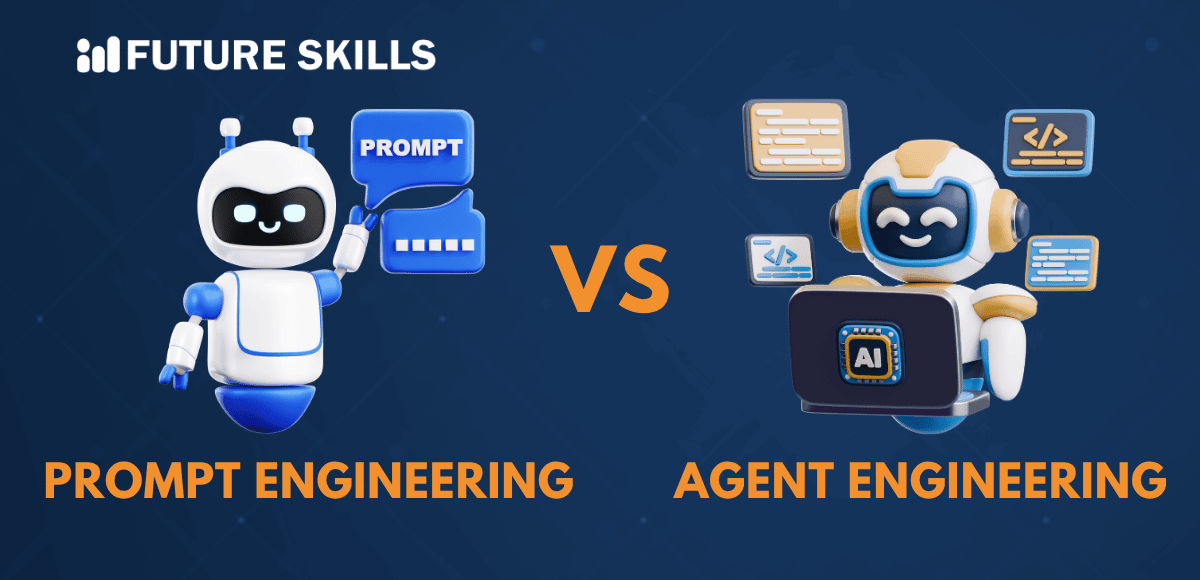

The transition of the AI landscape from large language models towards AI agents is a huge milestone in technology. You must understand the differences in a prompt engineering vs. agent engineering debate to figure out how the AI space has changed in the last few months. Prompt engineering offered the ideal solution to interact with foundation models and focused solely on optimizing the inputs for models.
The shift towards complex, multi-step workflows led to the arrival of agentic AI and prompt engineering was no longer adequate. Agent engineering came into the limelight as a systemic paradigm that empowers foundation models with cognitive architectures, external tool integrations and memory structures. The differences between prompt engineering and agent engineering can explain how AI shifted from guiding a model’s response towards creating completely autonomous systems.
Want to build a bright career in AI as a Certified Prompt Engineer? Enroll now in our new accredited Certified Prompt Engineering Expert (CPEE)™ Certification.
Understanding Prompt Engineering vs. Agent Engineering
The first step in unraveling the differences between prompt engineering and agent engineering begins with understanding the terms. You can get a general ideal of the agent engineering vs. prompt engineering comparison before diving into individual points of difference. The definitions of prompt engineering and agent engineering will show you how AI development has transitioned from input optimization to system design.
-
Prompt Engineering
The easiest definition of prompt engineering describes it as the art of asking the right questions to AI models. You can also think of it as the process of choosing the ideal structure, phrasing and format of inputs to draw optimal and contextually relevant responses from LLMs.
It is important to know that prompt engineering depends significantly on the internal statistical knowledge and in-context learning capabilities of the model. Most of the prompt engineering techniques work completely within the context window of a specific interaction or API call.
-
Agent Engineering
Agent engineering represents the holistic discipline that aims at developing stateful and autonomous or semi-autonomous AI systems. The big difference between agent engineering and prompt engineering is evident in the fact that agent engineering does not focus solely on the prompt string.
The working principle of agent engineering revolves around using the LLM as a cognitive core or reasoning engine within larger system architecture. Agents have the power of loop control mechanisms, environment perception, persistent state management, dynamic planning routines and standard interfaces. Therefore, agent engineering focuses on the LLM operating repetitively across a stateful lifecycle.
Gain in-demand skills to manage agentic AI workflows across the full AI agent lifecycle with the Certified AI Agents Manager (CAIAM)™ Certification
1. Unraveling Differences in Architectural Design
You can get a better idea of how prompt engineering and agent engineering work differently by learning about their architecture. The difference between operational mechanisms of prompt engineering and agent engineering depends significantly on the components that drive them.
-
Components in Prompt Engineering
The foremost component in prompt engineering is the set of system instructions, which serve as guidelines to define tone, behavior, safety guardrails and boundary constraints.
Prompt engineering relies on context ingestion through static or dynamically injected text snippets within the context window.
Formatting rules in prompt engineering establish the output limitations that offer more stability in structure of outputs.
Most important of all, the in-context demonstrations offer examples for input-output relationships, either in the form of mathematical steps or JSON schemas.
-
Components in Agent Engineering
The LLM serves as the core engine in agent engineering architecture and works like the primary decision-maker, evaluating the current environmental state and choosing the next actions.
Planning and control loops offer iterative execution frameworks in which the agent evaluates their progress towards desired goals, breaks down the sub-tasks and manages exceptions dynamically.
The prompt engineering vs. agent engineering difference is also visible in the use of the tool orchestration and execution layer. Agent engineering leverages this layer to use function calling frameworks, SQL query engines, REST API clients and isolated code execution sandboxes.
Agent engineering is incomplete without the memory architecture that combines short-term working memory with long-term memory.
The working of agent engineering also involves the use of guardrails like deterministic verification steps and rate limits along with human-in-the-loop elements.
Enroll now in the Mastering Generative AI with LLMs Course to achieve specialization in using evaluation metrics to create reliable and accurate generative AI models.
2. Structural and Operational Differences
The next crucial factor in the comparison between prompt engineering and agent engineering focuses on the difference in their structure. You have to think about many factors in the structural comparison between prompt engineering and agent engineering.
The primary unit in prompt engineering is the text prompt or string template while in agent engineering, it is the stateful control loop and system architecture.
The execution flow in prompt engineering is linear, while in agent engineering you will get a cyclic feedback loop.
State management in prompt engineering is completely stateless and depends on explicitly mentioned context. Agent engineering, on the other hand, is stateful and relies on persistent database and session state.
Prompt engineering has limited autonomy while agent engineering can independently select tools and break down goals into subtasks.
3. Technical Execution
The design and operational architecture of prompt engineering and agent engineering offer a clear overview of the differences between them. You can figure out more answers to “What is the difference between prompt engineering and agent engineering?” by focusing on their technical execution. It is important to know how the two different approaches maintain and update the execution state.
Prompt engineering follows a deterministic execution structure in which you send a request and the LLM generates tokens according to probabilistic distribution. The execution cycle in prompt engineering ends when the LLM reaches an end-of-sequence token.
Agent engineering works with dynamic control loops according to which the agent operates in a loop that follows popular cognitive frameworks. The raw output of LLM is not the final deliverable and is generally a request to invoke specific tools. The execution cycle in agent engineering follows a self-correcting feedback loop that helps in resolving errors in the middle of execution.
4. Skill Requirement
The final aspect in any overview of differences between prompt engineering and agent engineering focuses on the skills required in each approach. You must know that the transition from prompt engineering to agent engineering requires a shift in technical skills and mindset.
The agent engineering vs. prompt engineering debate focuses on shifting from linguistics towards system design. Prompt engineering relies a lot on intuition for natural language nuances and semantic clarity. On the other hand, agent engineering requires fluency in object-oriented and functional design, API orchestration and state machine modeling.
Prompt engineering focuses significantly on manual inspection while agent engineering uses automated evaluation pipelines. Agent evaluation frameworks look for tool call accuracy, recovery rates, resource costs and trajectory efficiency alongside measuring response quality.
Final Thoughts
The general assumptions about agent engineering suggest that it is something that will replace prompt engineering in AI development. You should use the prompt engineering vs. agent engineering comparison as a reference to learn how prompt engineering has been embedded in agent engineering. It is important to acknowledge that every autonomous agent relies on carefully structured prompts to address initial reasoning. Learn more about prompt engineering and agent engineering to get a better understanding of their broader implications for AI now.
FAQs
What are the key differences between prompt engineering and agent engineering?
The key difference between prompt engineering and agent engineering is that prompt engineering aims to create inputs that will get desired results from language models. On the other hand, agent engineering is a holistic discipline that focuses on designing a system that can think independently.
How does prompt engineering compare to agent engineering in chatbot development?
Prompt engineering in chatbot development focuses on creating precise inputs that will guide the responses of a single model. Agent engineering in chatbot aims to design autonomous systems with multi-step workflows. The AI can use external tools with agent engineering and make plans without constant human intervention.
Where can I find courses on prompt engineering and agent engineering?
You can find courses on prompt engineering and agent engineering at Future Skills Academy. It is the most trusted platform for comprehensive, self-paced courses on emerging technologies, especially AI. Learners can capitalize on the insights offered by qualified and experienced instructors in the courses by Future Skills Academy.
About Author

James Mitchell is a seasoned technology writer and industry expert with a passion for exploring the latest advancements in artificial intelligence, machine learning, and emerging technologies. With a knack for simplifying complex concepts, James brings a wealth of knowledge and insight to his articles, helping readers stay informed and inspired in the ever-evolving world of tech.