
Artificial Intelligence has certainly emerged as a highly promising technological innovation in the 21st century. It has revolutionized how human beings interact with technology in the present times. However, while talking about AI, it is essential to bear in mind the associated risks and threats.
AI is a novel technology that has given rise to a plethora of AI security threats and concerns. In order to leverage this novel technology in an optimal manner, it is imperative for you to broaden your insight into AI security risks. The holistic insight into this dimension can empower you to understand the potential of AI and how the related risks can be tackled in a strategic manner.
Open new career paths with our accredited AI Certification Course and transform your career in just four weeks. Enroll today!
An Insight into AI Security
The concept of AI security revolves around safeguarding systems from new and evolving AI security threats. AI security basically works by discovering anomalies and preventing attacks. It also involves the security of AI models and ensures the trustworthiness of the ultimate outcome. As AI is still in its infancy, one cannot ignore the associated risks. It is essential to address the question relating to: What are the security threats of AI?
In order to understand AI security comprehensively, you must remember that it covers two parts. The first is the use of AI in cybersecurity through the automation of threat detection and response. The second is the protection of AI systems from diverse AI security risks that exist in the volatile cyber environment. It is essential to understand as well as address both sides so that modern entities can capitalize on the strengths of AI and make sure that AI systems remain resilient and secure.
Security Threats of AI
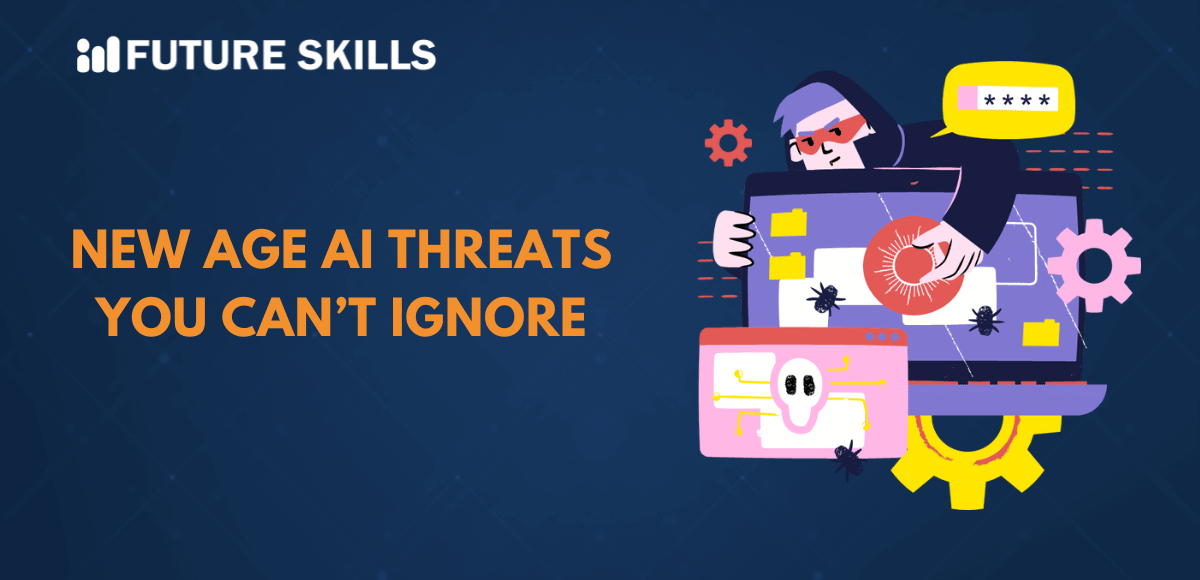
You may be wondering – What are the security threats of AI? AI security threats and risks involve the types of attacks that can manipulate training data as well as models. Some of the common types of threats that you may come across in the AI landscape are prompt injection attacks and data poisoning in AI. Apart from these types of security threats, it is essential to be careful about model theft AI.
As AI technology is still undergoing change, you need to keep a constant watch on the latest security threats of AI. You need to have updated knowledge in this area so that you can be well-prepared to deal with these concerns and risks in an effective manner. You can certainly consider becoming a Certified AI Security Expert so that you will be able to tackle AI security risks like a pro.
Get the professional training to enhance your AI expertise and uncover the significance of AI ethics with our unique Ethics of AI Course.
What is a Prompt Injection Attack?
A prompt injection attack refers to a cyberattack that can manipulate a large language model by sending it malicious inputs. Such inputs can override the original instructions. Cyberattackers and online criminals can exploit this in order to make an LLM generate harmful content. It can also lead to the leakage of sensitive data and the bypassing of security measures.
Such an attack is possible since both the system prompt of the developer and the input of the user are processed as natural language text. It thus creates a semantic gap that can be exploited by malicious parties. In such an attack, the attacker may directly insert instructions in order to jailbreak the model.
It can cause it to ignore the original programming and execute prohibited tasks. In the case of indirect prompt injection, an attacker is responsible for embedding malicious instructions in external data, like a webpage that the LLM will process. A prompt injection attack may also take place when an attacker can trick the LLM into ignoring the safety protocols.
It is essential to have in place suitable defense mechanisms to deal with prompt injection attacks. It is key to prioritize input validation. It can help detect as well as block malicious prompts. Similarly, regular human oversight is necessary. A human must be kept in the loop for critical actions.
What is Model Theft in AI?
Model theft AI refers to the unauthorized reverse engineering or copying of an AI model for the purpose of stealing its intellectual property. This specific attack can happen through the querying of a model’s public API in order to reconstruct its functionality. Otherwise, it may take place by gaining access directly to its weights or parameters.
The fundamental goal of Model Theft in AI is to develop a functional duplicate to gain a competitive advantage in a simple manner. This is because it does not require the significant time and resources that may have gone into the original. API exploitation is a common method of model theft. In such attacks, attackers basically send a significant number of queries to the public API of a model and analyze the outputs for building a new model that can emulate the behavior of the original model.
There exist diverse defenses against model theft. Some of the common types of defenses involve techniques such as watermarking and obfuscation. You may also focus on limiting the information that can be leaked through API responses.
Learn how ChatGPT and AI can transform your career and boost your productivity with the free ChatGPT and AI Fundamentals Course.
What is Data Poisoning in AI?
While talking about AI security threats, one cannot ignore the risk relating to data poisoning. Data poisoning in AI refers to a cyberattack that involves the intentional corruption of the training data of an AI model. The purpose is to manipulate the behavior of the AI model.
Malicious parties such as cyber criminals and online attackers may introduce misleading or malicious information, like bad data, so that the model can produce inaccurate or biased outputs. The purpose is to create vulnerabilities. Due to such an attack, a model may fail to carry out the intended function. The issue relating to data poisoning in AI may arise because of the injection of false data as well as the deletion of data.
In order to defend against such a threat, you can adopt diverse strategies. The common defense mechanisms that you can come across are securing the training data and anomaly monitoring. Additionally, it is essential to implement robust validation techniques that can help ensure the integrity of AI systems. It is essential to be prompt while adopting these strategies so that the risk of data poisoning can be curbed.
Final Words
The new threat landscape in AI security is filled with new kinds of risks and challenges. You need to be aware of the new risks so that proper preparedness can be ensured at all times. As the AI environment is evolving at a rapid pace, further risks and threats may arise in the future. It is key to adopt proper defense mechanisms so that diverse risks can be removed.
You must consider enrolling in a top course like Certified AI Security Expert offered by Future Skills Academy if you wish to adapt to the evolving threat landscape in AI security. The course will equip you to adopt best AI security practices in the practical setting.

About Author

David Miller is a dedicated content writer and customer relationship specialist at Future Skills Academy. With a passion for technology, he specializes in crafting insightful articles on AI, machine learning, and deep learning. David's expertise lies in creating engaging content that educates and inspires readers, helping them stay updated on the latest trends and advancements in the tech industry.