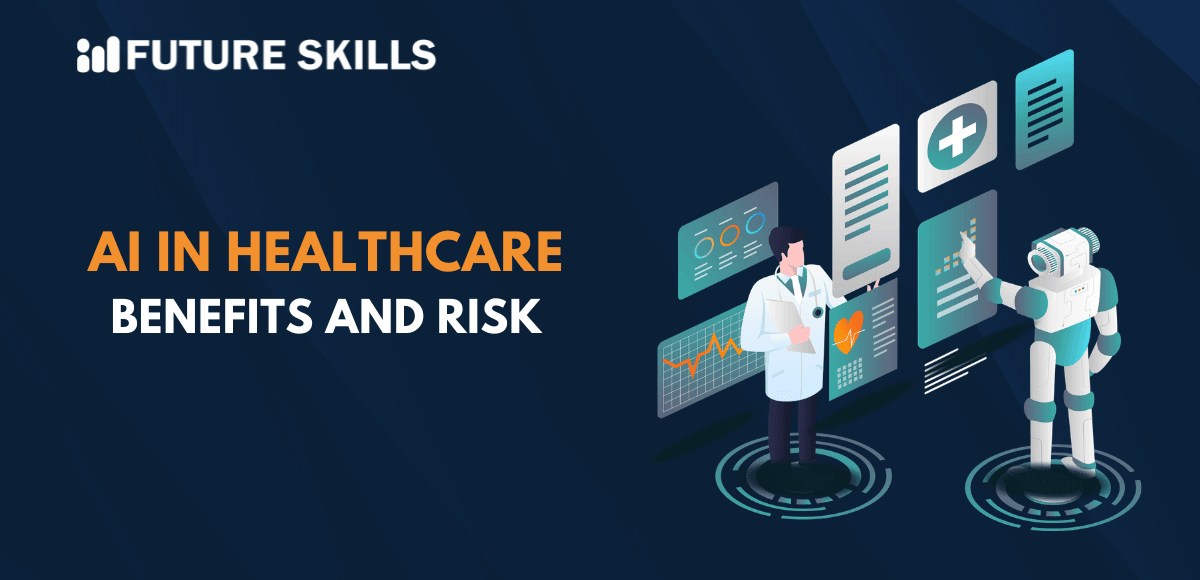

Artificial intelligence is gradually transforming the healthcare space with diverse benefits. It can not only improve efficiency in clinical decision-making but also provide the ideal platform for automation of administrative tasks. The discussions around benefits and risks of AI in healthcare also reveal that thoughtful and strategic implementation is essential to capitalize on the true potential of AI. You must know the benefits and risks of AI in the domain of healthcare to navigate effectively through implementation challenges.
- According to a report by OpenAI, over 40 million users ask healthcare questions to ChatGPT (Source).
- Almost 63% of healthcare professionals are active AI users with another 31% working on pilot projects or evaluating AI projects (Source).
- Insights from a report by Deloitte showcase that 64% of global health leaders believe in the potential of AI to reduce costs (Source).
The real use cases of AI in healthcare have attracted significant amount of attention in the last few years. At the same time, governments and healthcare organizations are constantly struggling to adapt to emerging risks with AI. Learning about the benefits and risks of artificial intelligence in healthcare can help you uncover insights for responsible and effective implementation of AI.
Level up your AI skills and embark on a journey to build a successful career in AI with our Certified AI Professional (CAIP)™ program.
How is AI Relevant in the Healthcare Sector?
Artificial intelligence represents technologies that help machines in performing tasks that will require human intelligence. The healthcare sector can capitalize on AI algorithms for analyzing and processing text, audio, video and images to detect patterns and relationships. You will find specific types of algorithms tailored specifically for applications in the healthcare sector.
- Deep learning algorithms help with image and speech recognition tasks.
- Natural language processing algorithms work on understanding and generating natural language.
- Computer vision algorithms are useful for interpreting data and analyzing objects, recognizing faces and other visual processing tasks.
- Reinforcement learning algorithms have become the most effective tools for training autonomous agents or systems to make sequential decisions.
The applications of AI in healthcare systems have potentially transformative effects that redefine various aspects of the healthcare industry. Artificial intelligence can help with automation of administrative tasks and workflows, thereby buying more time for leaders to focus on strategic priorities. The use cases of AI in healthcare also enhance treatment planning and personalization with more efficient diagnosis. AI also plays a vital role in enhancing risk management in the healthcare sector while providing better opportunities for clinical trials and drug discovery.
How Does AI Help in the Healthcare Sector?
Almost every industry is acknowledging the benefits of artificial intelligence and businesses want to adopt AI to stay relevant. It is important to find out how AI brings value to a specific industry like healthcare rather than joining the herd of organizations adopting AI blindly. Understanding the benefits of artificial intelligence for healthcare will help you identify strong business cases for AI adoption in healthcare.
-
Power of Predictive Analytics
Predictive analytics provides an effective solution to identify high-risk patients before their health conditions deteriorate further. The most outstanding AI in healthcare benefit revolves around how artificial intelligence brings a proactive attitude towards healthcare. Artificial intelligence opens the doors for early intervention and effective allocation of resources to prevent adverse health outcomes.
-
More Efficiency in Administration
Administrative tasks in healthcare, including the billing process and scheduling appointments, take up a lot of time and resources. AI can take care of these tasks and allow healthcare staff to focus on tasks that require critical thinking and personal interaction. The use of AI in healthcare administration helps in reducing manual data entry tasks and automation of appointment scheduling and invoice generation. It provides room for reducing operational costs alongside ensuring fewer errors in patient records and billing.
-
Enhanced Accessibility
You can notice the potential of AI to revolutionize healthcare in the different ways in which it improves accessibility to healthcare services. Artificial intelligence is a powerful enabler for telehealth services and can also drive mobile health apps, thereby bringing healthcare services closer to people. AI can help people in rural communities and remote areas to connect with experienced professionals through video consultations. AI tools can also help patients understand medical information without any cultural or linguistic barriers.
-
Benefits of Personalization
The most prominent benefit that trumps all disadvantages of AI in healthcare is the scope for personalizing healthcare services. Mobile applications, healthcare wearables and home monitoring systems can collect real-time patient data and AI helps in extracting valuable insights from patient data. AI algorithms can evaluate patterns in data points and point out anomalies, which will help in preventing minor issues from escalating into bigger problems.
-
Cost Reduction for Patients and Providers
Artificial intelligence can help in achieving significant reduction in operational costs through automation of routine tasks. The improvements in diagnosis accuracy and reducing hospital readmissions also help in saving the money of patients. Healthcare providers can find new ways to allocate resources to advanced medical research and essential services, especially when operating within certain budget constraints.
Level up your ChatGPT skills and kickstart your journey towards superhuman capabilities with Free ChatGPT and AI Fundamental Course.
What are the Limitations of AI in Healthcare?
Most of the discussions around use of artificial intelligence in the domain of healthcare shed too much light on benefits. You must also know about the challenges of AI in healthcare to understand the obstacles that you may find in the road to adopt AI healthcare. Understanding the risks of embracing AI in healthcare can help you identify the challenges in AI adoption and how to address them.
-
Problems of Ethics and Bias
You cannot think about a list of challenges in AI adoption without including ethics and bias. AI models and systems may harbor inherent biases in their training data, which can affect their ability to deliver fairness. Ethical concerns regarding AI bias require all AI deployments in healthcare to ensure adequate representation for all patient demographics in training datasets.
-
Data Privacy and Security
The next prominent challenge for adoption of artificial intelligence revolves around data privacy and security. Healthcare data is one of the biggest targets for cybercriminals and the use of AI systems increases the risks of data breaches. Without safety for patient data, patients are less likely to trust healthcare providers and providers will have to face legal issues. Comprehensive data governance mechanisms with strong and regularly updated security protocols play a major role in addressing emerging threats.
-
Limited Human Involvement
The outline of AI in healthcare risks also points at how the benefits of AI can increase dependency on AI systems. It is important to remember that the relationship between patients and healthcare providers develops with trust, effective communication and empathy. Depending too much on AI systems and restricting the human element can diminish the quality of care services.
-
Legal and Regulatory Complexities
One of the biggest challenges for healthcare providers adopting AI is the complexity of laws for AI. Regulatory authorities have been working on new guidelines for AI-powered medical solutions. Developers and healthcare providers might have a lot of second thoughts before adopting AI solutions without understanding the legal risks.
Healthcare providers should also keep an eye on other risks, including data quality and issues in integration with existing healthcare systems and data platforms. In addition, high upfront costs for developing and implementing AI systems also present a huge obstacle for AI adoption in healthcare.
Excited to understand the crucial requirements for developing responsible AI and the implications of privacy and security in AI, Enroll now in the Ethics of Artificial Intelligence (AI) Course
Final Thoughts
The overview of the benefits and risks of AI in healthcare showcases how adopting AI for healthcare requires strategic approaches. You must know that AI brings the benefits of automation and cost reduction to the healthcare sector. You should not ignore the ethical risks, legal complexities and data quality issues that can affect AI deployments in healthcare. Learn more about the utility of artificial intelligence in healthcare and figure out the ideal roadmap to adopt AI now.
FAQs
What are the main benefits and risks of AI tools used in healthcare?
The primary benefits of AI tools used in healthcare include improved speed and accuracy in medical diagnosis and drug discovery. AI tools also help in creating personalized treatment plans and streamlining administrative tasks with the benefit of automation. The risks of AI tools in healthcare include high upfront costs of implementation, ethical concerns and data privacy breaches.
Which AI-powered healthcare platforms offer the best balance of accuracy and safety?
You will come across many AI-powered healthcare platforms that claim to be the best picks for healthcare providers. However, you can identify healthcare platforms that offer the best balance of accuracy and safety in the ones that offer a blend of ambient documentation and human-in-the-loop processes. It is also important to check for clearance from FDA, especially for operations involving diagnostics and radiology.
How do AI diagnostic systems improve patient outcomes and what risks do they pose?
AI diagnostic systems help in improving patient outcomes through better diagnostic accuracy and proactive detection of diseases. The AI-powered diagnostic systems also help in creating personalized treatment plans with the help of advanced data analysis. However, AI diagnostic systems also pose risks of data privacy concerns, algorithmic bias and inaccuracy in diagnosis.
What are the top AI certification programs that include hands-on projects?
The Certified AI Professional (CAIP)™ certification program by Future Skills Academy is one of the top AI certification programs with hands-on projects. Learners can use the self-paced certification program to hone their AI skills and knowledge with hands-on exercises and real-world examples. You will also find hands-on projects in other certification programs by Future Skills Academy.
About Author

David Miller is a dedicated content writer and customer relationship specialist at Future Skills Academy. With a passion for technology, he specializes in crafting insightful articles on AI, machine learning, and deep learning. David's expertise lies in creating engaging content that educates and inspires readers, helping them stay updated on the latest trends and advancements in the tech industry.