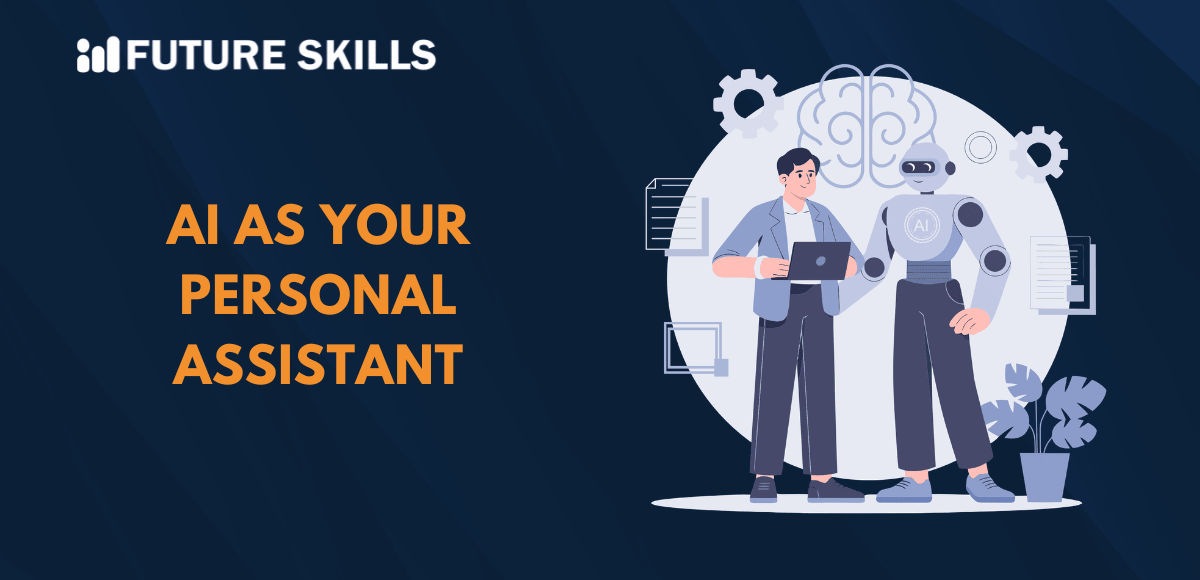

The conventional notion about digital assistants largely focused on their ability to follow simple voice commands. Personal digital assistants helped you check the weather, play a specific song or set an alarm on command. As the world prepares to use AI as personal assistant in personal and professional lives, it is reasonable to think how you can prepare for the transition.
- Almost 50% of US adults use AI chatbots in 2026, with a substantial growth from 33% in 2024. (Source)
- 51% of developers use AI assistants in their daily work, and 19% of consumers use AI assistants as primary research tools. (Source)
The thought of embracing artificial intelligence as a personal assistant instantly brings to mind the real productivity gains you can get from them. Many people interact with AI as chatbots in browsers and assume that it is the best it can do as a personal assistant. On the contrary, a personal AI assistant is in a completely different category, and you must understand its capabilities to make the best use of them.
Level up your AI skills and embark on a journey to build a successful career in AI with our Certified AI Professional (CAIP)™ program.
Understanding Identity of AI as Personal Assistant
If you think that your personal AI assistant will be a robot like WALL-E, then you are more farsighted. As of now, you will find AI personal assistants in software tools that run on large language models. The tools can help you with different types of tasks, including writing, research, analysis, and automation. Anyone trying to discover how to use AI as personal assistant must have used ChatGPT or Google Gemini. Each AI personal assistant comes with distinct capabilities tailored for various professional workflows.
Many people believe that using artificial intelligence as personal assistants will replace many jobs. However, AI assistants are more likely to bring the benefits of intellectual augmentation rather than replacing you. Artificial intelligence assistants will work as,
- Tools that learn from examples and outcomes
- Powerful enablers of workflow automation
- Resources for extending your professional capabilities
- Catalysts for improving productivity in writing, research and analysis
As you try to figure out what AI personal assistants are, it is also important to know what they don’t offer. You could not think of AI personal assistants as,
- Autonomous decision-making tools
- Tools that you can setup and forget how they are working
- Solutions that don’t require thoughtful implementation
- Replacement for domain expertise and critical judgment
Become a certified ChatGPT expert and learn how to utilize the potential of ChatGPT that will open new career paths for you. Enroll in Certified ChatGPT Professional (CCGP)™ Certification.
Unraveling the Changes to Expect with AI as Personal Assistant
You know how it feels to ask Alexa to play a song for you or point out the headlines for the day. What will the world be like when you find your coffee already brewing in the kitchen when you wake up? How will it feel when you see a comprehensive breakdown of all your overnight emails as soon as you unlock your smartphone? All of these scenarios may seem like they have been picked from a sci-fi novel.
The reality is no longer different as the maturity of autonomous AI agents and large language models has created new opportunities to transform AI into our personal assistant. You must identify the notable changes that will emerge as our relationship with technology changes with the growing use of artificial intelligence as personal assistants.
1. Shift towards Proactive Behavior of AI
The biggest difference that you will see with the rise of AI personal assistants is the proactive attitude shift. If you think about the AI chatbots, then you know that they operate directly on your commands. You entered a task as input, and the system responded exactly as it was programmed to for the specific problem.
The equation becomes completely different with modern AI personal assistants that can work with contextual awareness while retaining memory. It is important to remember that when you use AI as personal assistant, it works not only by reacting but also by anticipating. Your personal AI assistant will check your calendar, preference patterns, communication history, and other external data to identify potential pain points before you find them.
AI personal assistants will mark the shift of artificial intelligence from a tool for task execution to a tool capable of cognitive offloading. Artificial intelligence will proactively think about the mental overhead of various tasks in everyday life. As a result, humans can focus their attention on high-level and creative pursuits.
2. Addressing the Problem of Cognitive Surplus
The average professional makes thousands of decisions in a single day, ranging from small choices to decisions with higher stakes. From deciding which email to reply to first and what to cook for dinner to determining how to pitch an idea to a client, professionals have a lot to deal with. The problem is that all of these situations create decision fatigue for professionals, ultimately leading to mental exhaustion.
When you bring an AI personal assistant app into your life, it will work as a filter for the smaller decisions that have low stakes. You will delegate everyday tasks to AI and make the most of the cognitive surplus to manage other meaningful work. AI personal assistants will not let you waste time on digging through emails to find a specific invoice or a PDF file. The time and effort that you save from these tasks can be invested in more useful tasks.
3. Reducing Friction Points on the Internet
The way we navigate the internet may seem like a seamless experience on the surface. However, it is also important to ask whether we are enjoying a truly frictionless experience on the internet. If you want to plan a weekend trip, then you have to open a browser with multiple tabs and search for flights across different sites. On top of it, you will also look at different hotel ratings and read through various posts to find the best sightseeing locations.
AI personal assistants will do all these tasks on your behalf and reduce the number of points where you have to interact with the web. You don’t have to manually click through various web pages and can simply give an objective to the AI assistant. The assistant will look up travel booking platforms, reviews and check availability, followed by building an itinerary for your approval. AI personal assistants can become the sole interfaces to the digital world in the future.
4. Personalized Approach to Growing as a Person
AI personal assistants are not anything like the traditional digital tools that respond to certain triggers or actions. Artificial intelligence can adapt to your unique behavioral patterns over the course of multiple interactions. As a result, it can figure out how you deliver the best performance and when you are at your lowest.
You can expect rising adoption of AI as personal assistant in workplaces, especially for skill development and life coaching. AI assistants can tell you that you must change the time for brainstorming sessions, based on their observation of when your energy falls to the lowest. In addition, AI assistants can also tell you when you need to take a break by noticing your stress indicators. As a result, AI assistants can become personalized life coaches offering real-time feedback aligned with your personal goals.
Level up your ChatGPT skills and kickstart your journey towards superhuman capabilities with Free ChatGPT and AI Fundamental Course.
Final Thoughts
The vision of integrating artificial intelligence in our daily lives will finally become a reality with AI personal assistants. It is important to know that using AI assistants does not mean replacing human experience or critical thinking with automation. On the contrary, the actual benefits of AI personal assistants will revolve around reducing administrative overheads. AI assistants can handle routine and repetitive tasks while empowering us with cognitive surplus and time to focus on high-value tasks. Learn more about best practices to create your own AI assistant now.
FAQs
What are the best AI personal assistants for managing daily schedules?
The best AI personal assistants for managing daily schedules include Motion, Clockwise, and Reclaim.ai. Each tool uses AI to reschedule tasks, automate time blocking and reduce meeting overhead. Reclaim.ai is the ideal choice for flexible time blocking while Clockwise is the best pick for rearranging internal meetings to create more focus time. Motion stands out as the top assistant for automatic task scheduling.
How do AI personal assistants help with email organization?
AI personal assistants can help you with email organization with features like smart sorting, automated drafting, and thread summarization. Assistants use tools like Microsoft 365 Outlook AI to streamline workflows in email organization. The email classification begins with smart sorting in which the AI assistant splits the messages into different groups, assigns tags, and removes unwanted emails. Subsequently, the assistant distills long conversations and allows search in natural language to find files without extensive search.
What are the top AI personal assistants that integrate with smart home devices?
The top AI personal assistants that support integration with smart home devices include Amazon Alexa, Apple Siri, and Google Gemini. These AI assistants have distinct capabilities, including multi-turn natural conversations, user privacy priority, and complex context awareness.
About Author

James Mitchell is a seasoned technology writer and industry expert with a passion for exploring the latest advancements in artificial intelligence, machine learning, and emerging technologies. With a knack for simplifying complex concepts, James brings a wealth of knowledge and insight to his articles, helping readers stay informed and inspired in the ever-evolving world of tech.