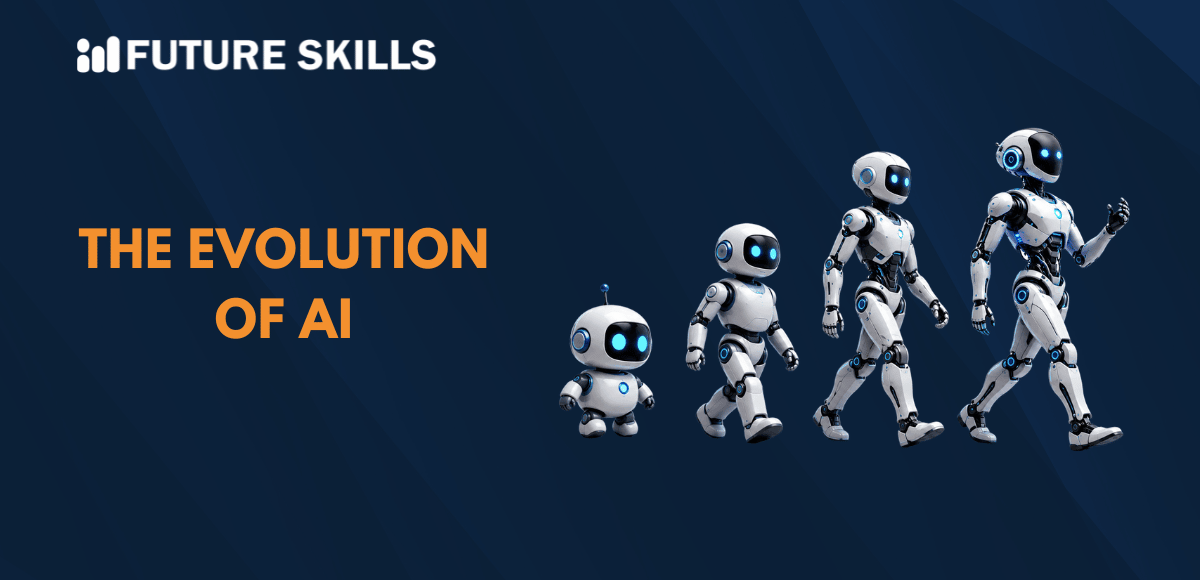

Artificial intelligence stayed in the realm of science fiction for a long time and required strong understanding of theoretical mathematics to even scratch the surface. In a radical turn of events, the evolution of AI has brought massive changes in almost every industry and everyday life. You can come across multiple examples of the applications of artificial intelligence in the real world, ranging from automated diagnostic tools to generative AI models spinning stories, writing code, and composing music.
Many people would assume that using AI was always as easy as it looks now. However, the technology that drove the AI revolution was completely different fifty years ago. Artificial intelligence has shifted from rule-based programming towards machine learning and then to the advanced stage of deep learning. Learning about this transition of AI will not only show how the technology has grown so far but also give an idea of what to expect in future.
Level up your AI skills and embark on a journey to build a successful career in AI with our Certified AI Professional (CAIP)™ program.
Unraveling the Earliest Phase in the Evolution of AI
The initial days of AI research focused predominantly on the fact that human intelligence can be represented as a combination of logical statements and symbols. It was the defining trait of old-fashioned AI and aimed to emulate or integrate human expertise directly through software.
Also known as rule-based AI, the first manifestations of AI systems worked on the ‘If-Then’ logic. The rule-based systems worked with two significant components, such as,
-
Knowledge Base
The AI included a collection of clear facts and domain expertise, represented in the form of “IF-THEN” statements.
-
Inference Engine
Rules-based expert AI systems also featured a logical processing unit that used inference rules on the input data and knowledge base to draw conclusions.
One of the best examples of rules-based expert AI systems is MYCIN, which used almost 600 rules to identify blood infections and recommend medication dosages. The system was so good that it outperformed junior physicians in diagnosis on many occasions.
Why Did the World Move on from Rules-Based AI?
The working of rules-based artificial intelligence definitely showed a lot of promise in emulating human intelligence in machines. On top of it, the rule based approach in AI offered significant benefits, including serving as the ideal choices for well-defined tasks with a narrow scope. Rule-based expert systems were also easier to debug with the transparency into how they work. Even though they performed exceptionally in predictable tasks, the structural limitations became hard to ignore.
-
Bottlenecks in Building Knowledge Base
The process of extracting nuanced knowledge from human experts, followed by its translation into explicit Boolean logic was extremely slow. In addition, the knowledge base always remained incomplete in certain aspects, thereby creating limitations for rule-based artificial intelligence systems.
-
Scalability Trouble
The growing complexity of real-world problems led to exponential growth in the number of rules required in rule-based systems. As a result, system maintenance and management became a daunting task.
-
Inability to Adapt
The biggest limitation of rule-based artificial intelligence is the lack of flexibility to adapt to new use cases. Even ambiguous inputs that did not meet the predefined rules, along with completely novel inputs, failed in rules-based systems.
All of these limitations led to loss of enthusiasm in artificial intelligence, and ultimately, funding for AI projects started declining.
Build ChatGPT skills and take the first step to becoming superhuman with our free ChatGPT and AI fundamental Course
Arrival of Machine Learning in the Evolution of AI
The rules-based approach showed that it is impossible to embed the world’s complexity in code. Therefore, researchers turned their focus towards giving machines the power to learn and figure out the rules of inference independently. Most of the answers to “How fast is AI growing?” reflect on the role of classical machine learning in changing how we view AI. Machine learning marked the shift of AI from deterministic formal logic towards probability, statistics, and algorithms.
The working of machine learning revolved largely around algorithms that can learn patterns from historical data and make predictions on new data. Some of the most popular groups of machine learning algorithms include supervised learning and unsupervised learning algorithms and ensemble methods.
With the introduction of machine learning, the AI landscape witnessed significant improvement and moved beyond symbolic rules. However, machine learning retained a huge limitation in the form of feature engineering, which required dependency on humans. Machine learning algorithms could not process raw data directly, and human experts have to convert raw data into structured numeric features that can be fed to AI models.
Gain a solid foundation in machine learning with Machine Learning Essentials Course, understand the real-world impact of various ML techniques, and build the skills to apply predictive analytics and optimization effectively.
Understanding the Paradigm Shift towards Deep Learning
The deep learning revolution began with the successful implementation of neural networks. Evidence regarding the development of artificial neural networks can be traced back to the 1980s. However, the concept appeared impractical for execution due to massive computational constraints and limitations in training data. The first successful deep learning model outperformed existing computer vision models with superior performance in reducing classification error rates.
The place of deep learning in the evolution of AI marks a formidable milestone as it removed the manual feature engineering limitation. Deep learning works through representation learning in which the architecture includes stacks of artificial neurons. The deep learning neural network starts by learning low-level patterns and then moves towards mid-level combinations and high-level concepts across different layers of their architecture.
Which Factors Drive the Growth of Deep Learning?
People who are trying to understand the shift from machine learning to deep learning must know about the major forces driving the transition.
-
Hardware Advancements
The sporadic growth of Graphics Processing Units, or GPUs, provided the perfect foundation for rise of deep learning. GPUs served as the ideal resources for huge parallel matrix computations required for neural networks.
-
Availability of Big Data
Deep learning also discovered momentum through the availability of billions of data points obtained from the internet, mobile devices, and IoT. The assurance of access to a huge treasure of data left no doubts for training massive models without the concerns of overfitting.
-
Innovative Algorithms
The shift towards deep learning has also been made possible due to innovative breakthroughs in algorithm design. Examples of batch normalization, Rectified Linear Units, and advanced optimizers showed how innovation has ensured stability in the training of deep neural networks.
Identifying the Major Milestones in Deep Learning
The transition from rule base AI towards deep learning is not the only shift you should know about. It is also important to understand the key milestones in the evolution of the architecture of deep learning systems.
One of the foremost developments in deep learning is the introduction of convolutional neural networks that served as ideal picks for spatial data. Similarly, recurrent neural networks emerged as the best choices for sequential data and natural language translation.
Transformer architectures in deep learning introduced self-attention mechanisms and unlocked many new capabilities. The utility of transformer architectures in ensuring huge parallel training on text is clearly visible in modern LLMs.
Final Thoughts
The evolution of artificial intelligence from rules-based systems towards deep neural networks showcases a significant change in the world of computer science. Rule-based systems aimed to incorporate human intelligence in machines directly through code. Subsequently, machine learning helped in ensuring that machines can learn from the given data and figure out relevant inference rules. The transition towards deep learning marked a leap towards the future of intelligent automation that makes AI work with limited human intervention. Across each stage of the evolution of artificial intelligence, innovation served as a primary driver to resolve prominent limitations. Learn more about the history of AI and how it has reached the stage it is in now.
FAQs
Which AI platforms offer capabilities that evolved from rule-based to deep learning models?
Conversational and enterprise AI platforms offer the best examples of platforms that evolved from rule-based systems into advanced deep learning models. IBM Watson Assistant and Google Dialogflow are some of the notable AI platforms that evolved from rule-based architectures towards modern deep learning frameworks.
Where can I find introductory guides on the history of AI evolution?
Future Skills Academy is the best platform to find introductory guides on the history of AI evolution. It is an independent training and certification platform that aims to prepare learners for emerging technologies. You can find comprehensive blogs featuring guides on the history of artificial intelligence and different milestones on the platform. Learners can get the opportunity to find valuable insights from expert writers who shed light on every stage in the evolution of AI.
How has artificial intelligence evolved from rule-based systems to deep learning in software products?
Artificial intelligence has evolved from the deterministic programming models towards more dynamic and data-driven architectures. The shift from rule-based systems to deep learning also marked evolution in the capabilities of AI-powered software products. With rule-based systems, AI relied heavily on ‘If-Then’ logic and worked effectively in highly structured environments for predictable tasks. Deep learning in software products brings modern capabilities as you can see in examples of generative AI models that can generate content.
About Author

David Miller is a dedicated content writer and customer relationship specialist at Future Skills Academy. With a passion for technology, he specializes in crafting insightful articles on AI, machine learning, and deep learning. David's expertise lies in creating engaging content that educates and inspires readers, helping them stay updated on the latest trends and advancements in the tech industry.