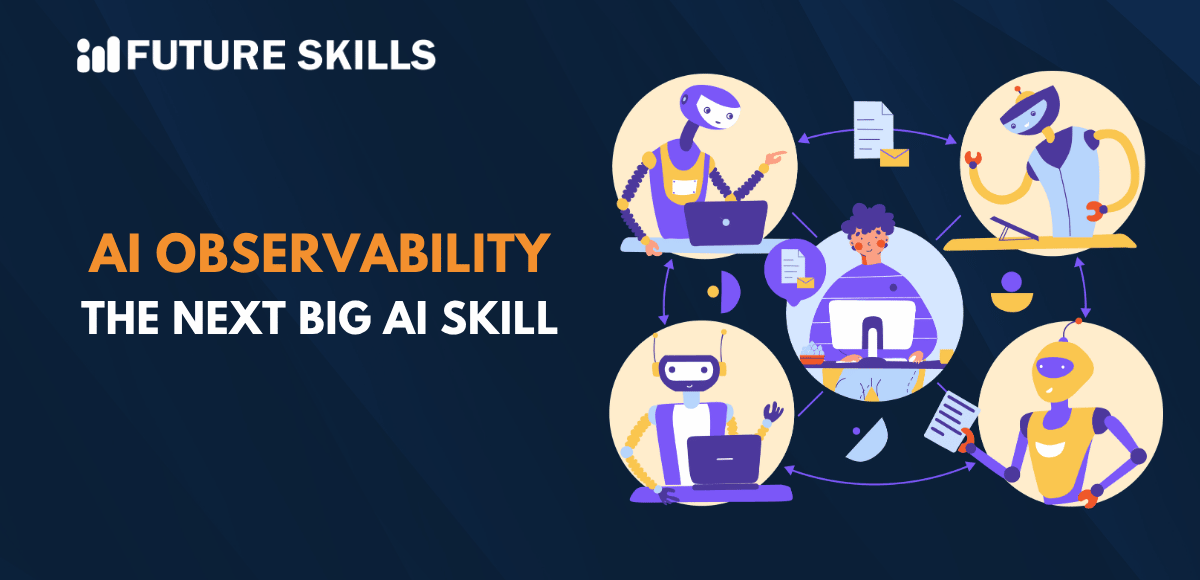

Almost every organisation is investing heavily in AI-powered assistants, search experiences, copilots, forecasting tools, and agentic workflows. Further, the demos look impressive, and the pilots create the hype as they are supposed to do. But once such systems move into real business processes, a different set of queries comes into the picture. This includes ‘why is the response quality getting worse?’, ‘Why did the model return this answer?’, etc. If such questions can’t be answered clearly, AI becomes challenging to trust. This is where AI observability becomes the highlight.
AI observability is the ultimate process of assessing artificial intelligence applications from source to embedding. So, if you use it correctly, it offers complete visibility into both the health and performance of AI in production. Further, you can also understand what went wrong, why, and how you can fix it quickly.
Learn how to use AI in different scenarios with our advanced Certified AI Professional (CAIP)™ Course and become a certified AI expert.
What are the Best AI Observability Tools for Enterprises?
The best AI observability platform for an enterprise is one that assists teams in monitoring AI applications, understanding model behaviour, verifying performance, and identifying issues before they affect users or business operations. Such platforms can bring together essential signals like latency, errors, models, token usage, user feedback, and data quality.
So, the right tool depends on the type of AI system that your company uses. Apart from this, running simple ML models might need basic model assessment. On the other hand, enterprise that uses LLMs and AI agents might require deeper visibility into agent actions.
- It should help your team understand how AI applications are performing in real and quick business conditions.
- The tools should easily trace issues back to their real sources.
- It should support monitoring across applications, models, data, and user interactions.
An effective AI observability platform generally brings together monitoring, tracing, evaluation, and performance analysis. Tools like Langfuse, Arize AI, LangSmith, Datadog, and Dynatrace offer capabilities that can help your team assess different parts of the AI lifecycle. However, the best choice depends on the organization’s AI stack, scale, security requirements, and monitoring needs.
- Model assessment can help your team track accuracy, drift, quality, and changes in model behaviour.
- Tracing assists developers in following an AI request across models, retrieval systems, tools, and agents.
- Evaluation features can help you assess whether AI outputs meet defined quality and safety standards.
Build practical expertise in AI observability, enterprise AI, and other emerging technologies with Future Skills Academy’s industry-relevant certifications and courses.
What Features Should I Look for in an AI Observability Solution?
Choosing an AI observability solution needs much more than checking whether it can assess an AI application. The right solution should give your team a clear view of what is happening across models, prompts, responses, and workflows. Further, it should also make it easier to identify issues and their influence.
1. Model and Performance Monitoring
A useful observability solution should track how your AI models work over time. It should help your team identify changes in accuracy, response quality, latency, and other performance indicators. This becomes especially essential when models are updated or their input data changes.
2. LLM and Prompt Tracking
For apps created with large language models, teams require visibility into prompts and generated responses. So, a good AI observability platform should allow developers to examine the interactions and understand how changes in prompts, models, or settings influence the final output.
- Track prompts, tokens, responses, and model usage.
- Compare results across different models or prompts.
- Verify unexpected or poor-quality responses.
3. Tracing and Root-Cause Verification
Enterprise AI applications can include a series of steps, including model calls, retrieval, tools, and agents. So, Tracing allows teams to follow an individual request through such a process. This makes it easier to locate where an error or performance issue actually occurred.
4. Data and Quality Assessment
AI outputs mainly depend on the quality of the data offered to the system. An effective observability solution should therefore assist your teams in monitoring input data, output quality, and retrieval quality. Further, this can help you detect issues before they become imminent.
-
Alerts and Dashboards
Your team needs to manually inspect AI systems every time something goes wrong. With proper AI observability guides and dashboards, you can get a central view of important metrics. On the other hand, automated alerts can notify the right people when performance drops, unusual behaviour appears, and errors increase.
-
Security Compliance
Enterprise AI systems might process sensitive business data, so security should be your major concern in any AI observability solution. Therefore, look for the features that can support access controls, audit trails, data protection, and compliance needs.
-
Integration and Scalability
An observability solution should work with the technologies already used by the organisation. It should integrate with AI models, applications, databases, cloud environments, etc.
Are you also keen to build skills in AI observability and enterprise AI? Future Skills Academy is offering industry-focused certifications and courses curated to help you understand emerging AI technologies.
Which Companies Offer AI Observability Platforms for Real-time Monitoring?
There are multiple companies that offer tools to help enterprises assess AI models, applications, and workflows in real time. So, while their features differ, these platforms mainly focus on areas like LLM tracing, model performance, data quality, and much more.
-
Langfuse
It is an open-source observability platform that prioritises LLM applications. Further, it helps developers trace LLM calls, evaluate responses, and understand how your users are interacting with the AI applications.
-
Arize AI
This company offers an AI observability platform curated to help your team monitor machine learning and generative AI applications. Further, it offers visibility into model performance, LLM traces, data quality, and production issues. It helps you investigate issues and improve AI reliability accordingly.
Level up your ChatGPT skills and kickstart your journey towards superhuman capabilities with Free ChatGPT and AI Fundamental Course.
-
LangSmith
It offers tools for evaluating, tracing, and assessing LLM and agent-based applications. It allows development teams to inspect individual runs and identify errors while comparing outputs and tracking application performance.
-
Datadog
It extends its application monitoring capabilities to AI and LLM-based systems. Further, its observability tools can help your enterprise monitor AI workloads alongside its existing infrastructure and performance data.
-
Dynatrace
This offers AI observability capabilities for monitoring the performance and behaviour of AI applications. Therefore, its platform can connect AI monitoring with broader application and infrastructure observability.
Final Thoughts
As enterprises continue to adopt AI, this blog can be your ultimate AI observability guide. This way, your ability to monitor and understand such systems will become just as essential as building them. AI observability can help your team track performance, improve output quality, identify issues, and maintain reliable AI applications in production. Learning how such platforms work therefore offers professionals a practical advantage as organisations look for people who can manage and improve their growing AI infrastructure.
FAQs
What is the ultimate tool for AI observability?
The right tool choice depends on an organisation’s AI system requirements. For teams deploying simple, single-feature AI applications, point solutions might be enough. On the other hand, enterprise teams at scale should consider a unified AI observability platform covering traces, metrics, evaluations, and logs.
Which test is used to determine AI observability?
There is no such single test to determine AI observability. It uses continuous production assessment against actual queries to measure the performance of AI systems. AI models undergo some types of quality evaluations like faithfulness, relevance, safety checks, and hallucination.
Is AI observability different from traditional application monitoring?
Yes, traditional monitoring mainly prioritises application performance, infrastructure, and system health. Further, AI observability also examines model behaviour, output quality, data changes, prompts, responses, and other factors that can influence the performance of AI applications.
About Author

David Miller is a dedicated content writer and customer relationship specialist at Future Skills Academy. With a passion for technology, he specializes in crafting insightful articles on AI, machine learning, and deep learning. David's expertise lies in creating engaging content that educates and inspires readers, helping them stay updated on the latest trends and advancements in the tech industry.