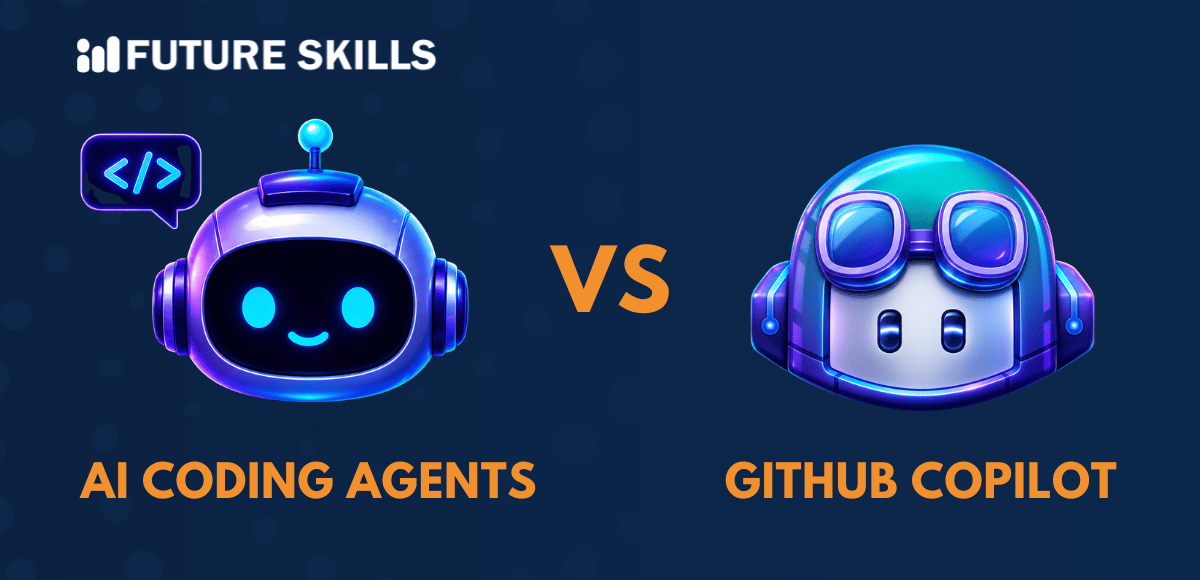

The relationship between artificial intelligence and software development has grown stronger with new innovations making a huge impact. You may have noticed how inline code completion tools caught the attention of the whole developer community few years ago. The curiosity to find differences in AI coding agents vs. GitHub Copilot comparison grows bigger as developers want the best solutions to make their work easier.
- In the Stack Overflow Developer Survey of 2025, almost 52% of developers believed that AI tools and AI agents help in improving productivity (Source).
- Gartner had predicted in 2024 that around 75% of software engineers will rely on at least one AI coding assistant by 2028 (Source).
- As of January 2026, GitHub Copilot had more than 4.5 million paid subscribers, indicating strong adoption (Source).
The popularity of GitHub Copilot has grown to an extent where it would not be wrong to say that it is the standard tool for AI-assisted coding. On the other hand, the shift from using AI as a coding partner to an autonomous coding tool is something developers should not ignore. Is GitHub Copilot better than completely autonomous AI coding agents? You can find the best answer to this question only by learning about the differences between them.
Gain in-demand skills to manage agentic AI workflows across the full AI agent lifecycle with the Certified AI Agents Manager (CAIAM)™ Certification
Understanding the AI Coding Agents vs. GitHub Copilot Debate
You want a list of differences between coding agents and GitHub Copilot and you don’t know the first thing that you should look for. The best way to begin searching for answers to “What is the difference between an AI agent and Copilot?” involves understanding exactly what you want to compare. From the outset, coding agents and Copilot look like the same tools with different branding. On the contrary, diving deeper into what coding agents and GitHub Copilot can do will show you that they are significantly different from each other.
-
GitHub Copilot: The OG Coding Assistant
When you think of the first set of tools that revolutionized coding with AI, GitHub Copilot will obviously pop up in the list. It has completely revolutionized how developers write code by serving as a valuable coding assistant rather than as an auto-complete tool. The deep integration of Copilot in any IDE along with its reactive architecture ensures that it can leverage LLMs to draw accurate prediction for the next line or block of code.
You might wonder about the utility of GitHub Copilot as a coding assistant when all it can do is autocomplete your code. It is important to remember that Copilot has evolved from being a simple autocomplete tool to a multifaceted assistant with agentic AI capabilities. The Copilot coding agent and its “Agent” mode clearly showcase that it is not your regular AI coding assistant. Copilot is the reliable partner you need to deal with the challenges of repetitive syntax, algorithm issues, and complex boilerplate setups.
-
AI Coding Agents: The Autonomous Developers
How do you think coding agents have an advantage over GitHub Copilot? The functionalities of Copilot will obviously have you asking such questions as it looks like everything a developer needs. However, AI coding agents offer the benefit of autonomy, which you cannot find in GitHub Copilot. Coding agents use agentic workflows rather than following loops of execution, feedback, and improvement.
AI coding agents don’t wait for continuous prompt triggers and work autonomously to achieve a high-level goal in coding workflows. Every coding agent comes with a distinctive sandbox environment, browser capability, and terminal access. In addition, AI coding agents can also use specialized tools, depending on the goals they want to achieve. The primary working mechanism of coding agents involves breaking down an objective into sequential tasks and executing them, followed by analyzing errors and changing its path accordingly until completing their objective.
Level up your ChatGPT skills and kickstart your journey towards superhuman capabilities with Free ChatGPT and AI Fundamental Course.
Unraveling Differences in AI Coding Agents vs. GitHub Copilot Comparison
The basic overview of GitHub Copilot and AI coding agents along with their functionalities show what they are capable of. Copilot ensures that developers don’t have to write code from scratch and all you have to do is review the code generated by LLMs. On the other side, AI coding agents make you a high-level system architect capable of designing workflows rather than reviewing code. A deep dive into the differences between Copilot and coding agents will help you pick the ideal solution for your coding requirements.
-
Autonomy and Agency
The foremost point of difference in a GitHub Copilot vs. AI coding agents comparison will point at the level of autonomy they offer. With GitHub Copilot, developers have lower agency as it is not capable of executing code natively or viewing the output of a local runtime compiler. It works strictly within the limits of the prompts provided by software developers and engineers, thereby reducing its potential.
AI coding agents stand out as winners when it comes to autonomy as they work with agentic architectures. The architecture of agents enables them to read the stack trace in event of an error during compilation or execution. As a result, agents can adjust the internal logic and rewrite the code without human intervention. Coding agents can also run recursively through debugging loops multiple times before the system achieves seamless compilation.
-
Context Window and Project Awareness
One of the distinct traits of GitHub Copilot is that it works with a localized context window. New updates can draw context from related code symbols, workspace indexing, and open files while the core focus of Copilot is always on the current task. The localized scope of Copilot makes it a trusted choice for micro-tasks albeit with challenges in understanding the impact of changes in the root module of a repository on microservices.
The AI coding agents vs. GitHub Copilot battle draws the limelight towards capabilities of coding agents in managing context throughout the system. Every coding agent begins working after systematic indexing of the complete codebase, developing structural dependency graphs, and defining structural relationships. With broader project awareness, AI coding agents can go through source file and identify deep-seated architectural issues across different layers of the stack.
Enroll now in the AI for Business Course to understand the role and benefits of AI in business and the integration of AI in business.
-
Flexibility for Human-in-the-Loop
The level of human interaction is also a notable point of difference between AI coding agents and Copilot. In the case of GitHub Copilot, you will notice synchronous and constant interaction with developers. If you stop typing, Copilot will stop generating suggestions.
AI coding agents work with an asynchronous interaction model in which developers can start the task and leave it there. The agent will work independently and ask the developer for help when they face ambiguities while taking architectural decisions. Coding agents can also prompt developers and engineers when they need API credentials or the final approval before moving into production.
-
Highs and Lows in Operational Capabilities
The most common approach to understand the differences between GitHub Copilot and coding agents requires learning about their capabilities. You can find answers to “What is the difference between an AI agent and Copilot?” with an outline of the areas where both tools excel and struggle. GitHub Copilot is the best pick for scenarios where developers work with micro-tasks and need total creative control. On the other hand, you cannot assign Copilot to solve an open issue ticket or tasks that require complex refactoring.
AI coding agents are the top choices for end-to-end feature development and workflows that require in-depth issue resolution. Coding agents also play a pivotal role in ensuring continuous technical debt reduction by patching old security flaws and upgrading legacy packages. However, AI coding agents also struggle with limitations like possibilities of model drift, hallucination, and higher operational costs.
Final Thoughts
The insights from a comparison between AI coding agents and GitHub Copilot clearly reveal that both of them have revolutionized coding. AI coding agents have an upper hand over Copilot in many areas, especially in terms of autonomy and context awareness. On top of it, coding agents also provide advantages of continuous technical debt reduction and supports tasks that require complex refactoring. Learn more about GitHub Copilot and its capabilities to discover how it is adapting to the agentic AI phenomenon.
FAQs
What are the differences between AI coding agents and popular code completion tools?
AI coding agents are different from popular code completion tools in their capabilities to understand high-level goals and execute multi-step workflows across the complete codebase. Most of the popular code completion tools follow a reactive architecture and work directly in IDEs to auto-predict the next line or block of code.
What are the key differences between autonomous AI coding solutions and advanced code completion tools?
You can find the key differences between autonomous AI coding solutions and advanced code completion tools in their primary goals. Autonomous AI coding solutions focus on completing end-to-end software development tasks independently while code completion tools help with faster coding by offering suggestions.
What are the leading certification programs for AI agent development skills?
The Certified AI Agents Manager (CAIAM)™ certification course by Future Skills Academy is the leading certification program for AI agent development. It will help you become an expert in the fundamental concepts of agentic AI and understand agentic AI architecture along with the core components. You will also learn about AgentOps and best practices for performance optimization and risk control in the certification program.
About Author

David Miller is a dedicated content writer and customer relationship specialist at Future Skills Academy. With a passion for technology, he specializes in crafting insightful articles on AI, machine learning, and deep learning. David's expertise lies in creating engaging content that educates and inspires readers, helping them stay updated on the latest trends and advancements in the tech industry.