
The direction of the artificial intelligence revolution has shifted towards autonomous AI agents. Businesses across different industries have acknowledged the potential of agentic AI to transform conventional business operations and workflows with efficiency. The discussions around LangChain vs. CrewAI vs. LangGraph debates point at the fact that every agentic AI project is looking for the best frameworks. If you look closely, AI agent frameworks have made AI agent adoption significantly easier for enterprises.
- A leading publisher leveraged AI agent by Salesforce to achieve 40% improvement in service efficiency (Source).
- Almost 62% of organizations are already experimenting with agentic AI to unravel new possibilities (Source).
- Companies claim that AI agents reduce the time required across the complete development lifecycle by around 58% (Source).
How are organizations capitalizing on the value of AI agents in their operations? AI agent frameworks provide the answer as platforms that help in building autonomous systems with the capabilities for perception, reasoning, and action on their own. Agentic AI frameworks play a vital role in abstracting low-level complexities and speed up the development process at scale. Comparing the most popular agentic frameworks will help you identify the ideal option for sophisticated agent implementation.
Gain in-demand skills to manage agentic AI workflows across the full AI agent lifecycle with the Certified AI Agents Manager (CAIAM)™ Certification
Understanding the Basics of AI Agent Frameworks
The demand for AI agent frameworks has been increasing with the continuously growing momentum in adoption of agentic AI. These frameworks serve as ideal tools to develop systems in which language models can make decisions, access different tools and apps, and take relevant actions without consistent human involvement.
The LangChain vs. CrewAI debate emerges from the fact that every business wants the best agentic AI frameworks. With the right framework, you don’t have to worry about writing complex scripts and prompt engineering. On the contrary, you can leverage these frameworks to set up systems with reusable workflows, multiple agents, memory, and tools.
Does the World Really Need AI Agent Frameworks in 2026?
AI agent frameworks have moved from the experimentation stages to redefining how businesses work. You should choose the right agentic AI framework as it will have a huge impact on the bottom line of every business. Agentic AI frameworks like LangChain, LangGraph and CrewAI deserve your attention because,
- AI agents are transforming the workforce and support business transformation with intelligent automation.
- Agentic AI frameworks reduce time and manual effort in building agentic systems, delivering more efficiency across various industries.
- Many frameworks offer no-code agents and in-built templates, allowing anyone to build their agentic systems.
- AI agent frameworks also offer features like audit logs and access control, which makes them trusted choices for security.
- Agentic frameworks also play a vital role in long-term planning with the flexibility to add new tools, change LLMs and introduce new agents.
Learn how to use AI and generative AI skills in your business or work with our AI for Everyone Free Course. Enroll now!
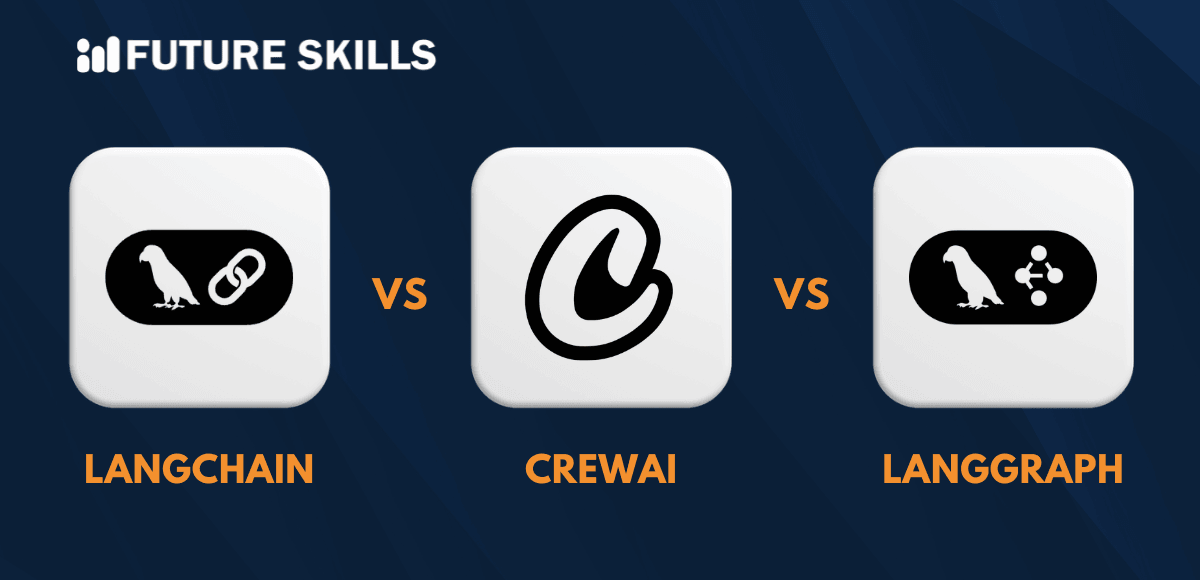
Unraveling the LangChain vs. CrewAI vs. LangGraph Comparison
The first category of AI agent frameworks that you will come across includes code-first frameworks. You will need code-first frameworks in multi-agent systems and in scenarios where you have human-in-the-loop workflows. Code-first frameworks offer various libraries and primitives that can help you build agents in the language you want.
The common trait of all code-first frameworks is the flexibility to control the orchestration logic, deployment, and memory. You can use a comparison between the top three agentic frameworks to identify the ideal choice for your agentic project.
-
LangChain
LangChain is one of the leading agentic AI frameworks with the highest number of downloads. It is a Python agent framework that offers more than 1000 model and tool integrations with benefits of semantic versioning, human-in-the-loop patterns, and detecting personally identifiable information.
-
LangGraph
The LangGraph vs. LangChain comparison also brings attention towards LangGraph, a lower-level runtime. LangChain runs on LangGraph internally and has extremely high abstractions, thereby making LangGraph a layer below the abstractions instead of an alternative ecosystem.
-
CrewAI
CrewAI has found its place among top AI agent frameworks with unmatched enterprise production adoption. As a matter of fact, big companies like IBM and PwC use CrewAI for its ability to replicate how humans organize their work.
You can compare these three popular agentic AI frameworks on the basis of certain criteria to unravel the ideal option for your next agentic AI project.
Want to gain practical skills in using OpenAI API and implementing API calls to facilitate LLM interactions, Enroll now in the Certified Prompt Engineering Expert (CPEE)™ Certification.
1. Developer Experience
Since we are talking about code-first frameworks, the first point of difference is about developer experience required for the frameworks. LangChain is model-agnostic and delivers the assurance of speed in standard use cases albeit with slower onboarding. Teams that look for type safety and debuggability are likely to gain less from the breadth of LangChain. Irrespective of its reputation, LangChain has an unparalleled ecosystem and is a functionally better agentic experience.
The learning curve for developers with LangGraph is considerably steeper with essential document fragmented across LangGraph and LangChain sites. With its explicit model and verbose design, LangGraph offers more control albeit with difficult developer experience.
The LangChain vs. CrewAI comparison emphasizes on how CrewAI allows developers to set up a group of agents easily. However, it presents some prominent limitations during debugging with black-box abstractions and complex conditional logic.
2. Agent Capabilities
LangChain offers rapid prototyping with a wide variety of tools supported by MCP server connectivity that enables access to all modern APIs. It has more than 300 community integrations that you can use as readymade tools.
LangGraph serves as the right choice in scenarios where you need cyclic agent loops and human-in-the-loop workflows. The checkpoints at every node transition with LangGraph ensure that agents are immune to server restarts. It also offers support for multi-agent coordination at scale and allows you to replay or fork execution from prior checkpoints.
The LangGraph vs. CrewAI debate turns in favor of CrewAI when you work with role-based multi-agent systems. You can rely on CrewAI for event-driven orchestration when autonomous delegation seems too risky. In addition, the framework also supports more than 20 LLM providers and over 30 in-built tools along with MCP servers.
3. Context and Memory
The comparison between agentic AI frameworks will be incomplete without reviewing their abilities to retain context and memory. LangChain offers eight memory classes, and the recent release version comes with another memory class for autocompression. You have to choose your memory class manually, which is a setback from frameworks that handle compression automatically without configuration.
LangGraph uses the memory saver to ensure automatic checkpoints at every state transition. You can come across two prominent limitations with context and memory in LangGraph, with the first one being the lack of native token budget management. On top of it, LangGraph maintains a full copy of the state, thereby calling for offloading large files to external storage.
CrewAI comes with a unified ‘memory’ class with four distinct types, including short-term, long-term, entity, and contextual memory. It does not have an in-built token budget limit like LangGraph, thereby turning token cost into a production risk. Therefore, you will have to set limits and verify costs with the LLM provider dashboard rather than relying internal reports.
Unlock new opportunities in your career with the power of Generative AI and LLM expertise — elevate your skills with the Mastering Generative AI with LLMs Course.
Final Thoughts
The decision to pick an agentic AI framework is considerably difficult when you have so many great options to choose from. You can see that the LangChain vs. CrewAI vs. LangGraph comparison showcases how every framework has unique strengths and limitations. As of now, you cannot find a one-size-fits-all framework for agentic AI implementations and it is important to choose frameworks that align with your requirements. Learn more about agentic AI and how to pick the right framework for your next project now.
FAQs
What are the main differences between three popular AI development frameworks?
The main differences between the three popular AI development frameworks are evident in the areas of developer experience, context, memory, and agent capabilities. For example, LangChain is ideal for single-agent systems while LangGraph is useful for multi-agent systems, and CrewAI is perfect for cyclic loops and human-in-the-loop workflows.
Which AI platform offers better integration options for building chatbots?
Microsoft Copilot Studio is the best AI platform offering promising integration options to build chatbots. It provides direct integration with Microsoft product ecosystem and allows developers to leverage MCP servers for deeper integration.
Where can I enroll in an accredited AI agent certification?
You can enroll in an accredited AI agent certification at Future Skills Academy. It is an independent professional training and certification platform that aims to prepare professionals for the future of technology. Learners can choose self-paced certification courses to become certified AI experts while working or studying and gain a competitive edge in their career.
About Author

James Mitchell is a seasoned technology writer and industry expert with a passion for exploring the latest advancements in artificial intelligence, machine learning, and emerging technologies. With a knack for simplifying complex concepts, James brings a wealth of knowledge and insight to his articles, helping readers stay informed and inspired in the ever-evolving world of tech.